

A triathlete and a canoe club build the toughest official trails in Germany
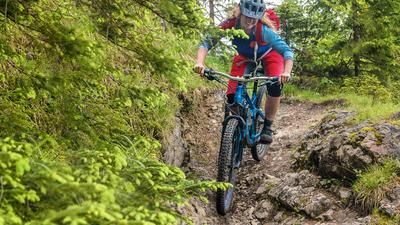
You've heard the biker noises in the POV shots by now, when someone enters a really steep section and just manages to make the next bend. Sooner or later, these breathless oohs and head-voiced woohoos can also be heard in every video about the Bikeländ in Eberbach. Certainly when the cameraman hits one of the three black trails. And as is rarely the case in POV images, you can see how steep the terrain is through which the towel-width trails run in the fall line towards the Neckar river.
The four hills around Eberbach - 30 kilometers east of Heidelberg - are the home turf of Marvin "Mupfen" Kaufmann, German enduro racer in the Nicolai Team and winner of Trans Madeira 2022. He grew up in the area and developed his speed on technical trails. However, Kaufmann also witnessed how the bikers became more and more hostile and how more and more trails were covered in wood. So he and his buddies took to the road. They went to the city council with a map and showed them all their trails and asked how they could get them legalized. This is how he told the reporter from the German GMBN.


Triathlete in the office marathon
And this is where the triathlete comes in. Timo Bracht, multiple Ironman winner and also an Eberbach local, had the stamina to ride through all the necessary discussions and procedures with the city authorities. "It was just as long and painful as an Ironman," he explains over the phone. But because he wants to do something good for his homeland and continue to enjoy the trails himself, he embarked on the adventure.
Heiko Mittelstädt from the German Mountain Bike Initiative Dimb helped him with this. "The Dimb has been recommending an uncomplicated procedure for approving single trails for several years," he explains over the phone. These are intended for technically experienced riders - in other words, those who are not happy on two-metre-wide forest roads.
"The approval process for new recreational trails has been known for decades and is relatively simple," he continues. "In Baden-Württemberg, an exemption from the 2-meter rule must also be granted by the forestry authority so that narrow paths can be used by mountain bikes." With this knowledge and a lot of experience in working with authorities, forestry, hunting and landowners, Mittelstädt guided Bracht and his colleagues through the process.
12 trails survived the process and are now officially approved for cycling. The bikers didn't have to give up a handful of trails. Virtually nothing was newly created, the trails were already there. Jumps and berms must not be too high so that they do not require planning permission. As a result, the Bikeländ routes look like informal trails and, according to eyewitnesses, ride like them. And because hardly anything was newly built or paved, it cost almost nothing. The entire trail network cost 35,000 euros. Most of the money was spent on signage and communication.
All the trails can be combined to form a 45-kilometre enduro loop with 1800 meters of elevation gain. If you do the math, you'll see that the difference in altitude per descent is not huge, nor is the length. The level of difficulty, on the other hand, is very high in places.
The canoe club as trail sponsor
"So where is the canoe club?", some of you may be asking yourself. Paddling has a long tradition in the small town on the Neckar, and the Eberbach Canoe Club will be 100 years old this decade. Biking has long been a popular recreational sport. "I think the current president of the club was the first person to have a mountain bike in Eberbach at the end of the 1980s," recalls Timo Bracht. But because there is no mountain bike club in Eberbach, the canoe club provided the structure needed to negotiate with the authorities. It's also practical that Bracht's wife Bettina is responsible for the recreational sport there.
The canoe club has undertaken to look after the trails and keep them in good condition. Mupfen Kaufmann explains that two people are responsible for each trail as trail sponsors. If something needs to be repaired, they either do it themselves or bring it to the attention of the responsible city authority. "The trails are worth something to the city," emphasizes Bracht.
However, this task could also become a major test for the traditional club. The trails are only run-in, not paved. If hordes of bikers were to take the bike terrain under their tires, the fine trails could turn into deep ditches. Erosion can leave particularly clear traces on steep terrain where there is a lot of braking. "We can do that," Timo Bracht is convinced, "we have the power to do it." Trail maintenance brings new life to the club, he says, describing the mood.
At the moment, the rush is great and the strain on the trails is high. "That's why it's so important that we have so many trails," explains Bracht. "Some people initially thought we were asking far too much. But it's important to spread out the twelve trails so that the individual trails don't suffer too much." What's more, the Bikeländ is not a bike park. The bikers have to gain every meter of altitude under their own steam. This limits the number of descents that a single mountain biker can make. The question is how many will travel to Eberbach in the coming months and years to let off steam on the twelve trails.The important thing is that the project is a success story. In Baden-Württemberg, which is known for being rather bike-sceptical, another municipality has transformed informal trails into an official trail network in just a few years, something that most Swiss towns can only dream of.
Further content on this article


Note: This content has been automatically translated from German. Please report any incorrect translations.