

Bigger Wheel, More Strokes? The Blind Spot of 29- and 32-Inch Wheels
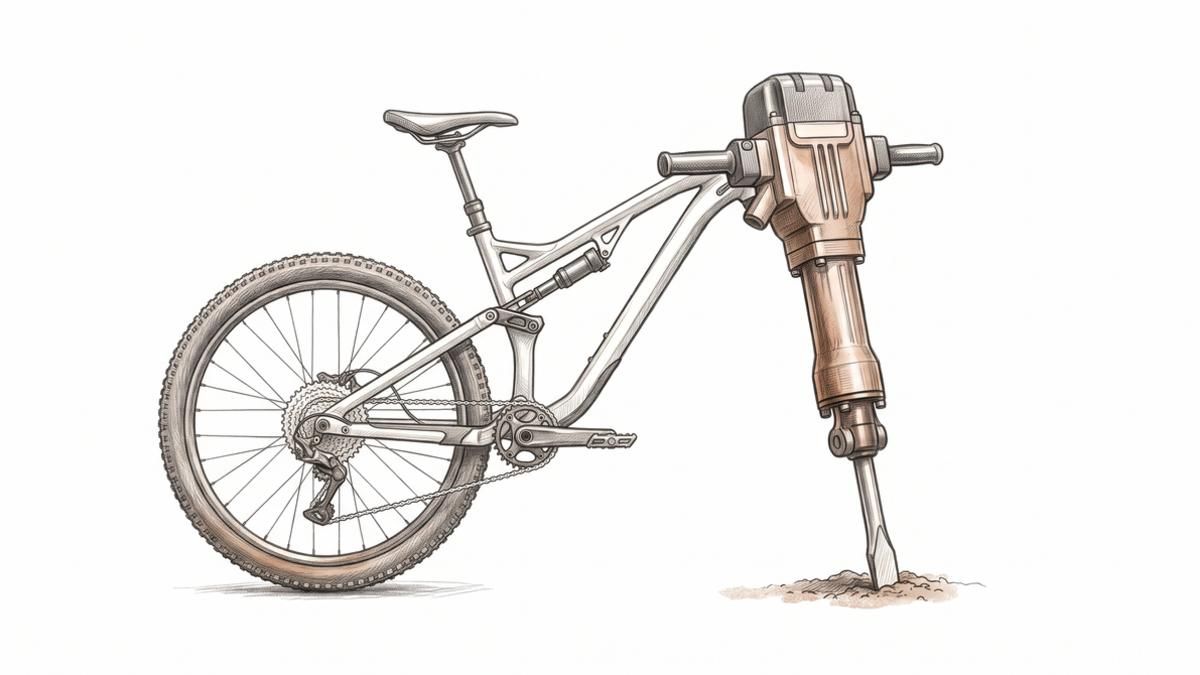
When buying a mountain bike, the focus is on weight, travel, head angle, and wheel size. Hardly anyone pays attention to the vibration levels at the handlebars. In a 2026 study, 49 mountain bikers rode a 52.3-meter test course, once on a 26-inch bike and once on a 29-inch bike. Going downhill, the larger wheel transmitted more vibration to the wrists and ankles; going uphill, the smaller wheel transmitted more to the tailbone. A larger wheel rolls more easily over an obstacle, but that doesn’t mean your hands take fewer impacts.
Faster doesn’t mean smoother
The 29er has won the long-standing wheel size debate. While the 29er wasn’t clearly faster in all studies, the larger wheel still prevailed on race tracks, and the 26-inch wheel virtually disappeared. Better roll-over performance is often associated not only with greater speed but also with greater comfort. So far, no one has been able to prove this—quite the opposite, in fact.
In 2021, a research group at the University of Valencia compared vibration transmission on 26-inch and 29-inch bikes. Fifty-five riders completed a circuit of just over two kilometers, equipped with sensors on their bikes and bodies. The 29er was faster than the 26er and, at the same time, transmitted more vibration to the wrists. The study provides no evidence against large wheels, but it does offer a counterexample to what the industry promises: A mountain bike can roll more easily over an obstacle and still transmit more vibrations through the handlebars to the wrists. Whether the difference is large enough to affect fatigue or control remains unanswered.
The cause of the higher readings is also not entirely clear. The tests were conducted on complete mountain bikes, with all the necessary components: tires, tire pressure, geometry, and weight. Scientifically, therefore, the difference cannot be attributed solely to the additional three inches. For developers, this raises a more interesting question: Can vibration transmission be reduced through tires, tire pressure, or suspension without sacrificing the advantage of the larger wheel?
32 inches comes without measurement data
When switching to 29 inches, the main focus was on measuring how much faster the larger wheel is. Before taking the next step to 32 inches, the counter-question should be asked: How much vibration does the entire mountain bike transmit to the rider? This can be measured with a sensor mounted on the handlebars. The spec sheet lists weight and geometry, but nothing about vibration levels.
Starting this season, 32-inch wheels are permitted in the Cross-Country World Cup. As early as the summer of 2025, BMC brought a 32-inch prototype to the World Cup, and Titouan Carod used it to collect data during training. At the time, BMC said they had more questions than answers. A vibration rating isn’t as easy to compare as the weight of a mountain bike. Even a different tire pressure, a softer casing, or a higher speed can alter the values measured at the hands. That makes a precise comparison difficult. Currently, there is no controlled comparison between 27.5-, 29-, and 32-inch wheels in enduro or downhill use. Nevertheless, comparisons on test stands and test tracks under identical conditions could show whether the effect can truly be attributed to the diameter and how the 32-inch wheel performs.
Perhaps this will reveal that the diameter is less important for vibration transmission than the tires, tire pressure, or suspension. The 29er has become the standard for good reasons, and the 32er may well do the same. No vibration measurements for 32-inch wheels have been published to date.
Sources
- Moreno-Mañas, Llana-Belloch, Monfort-Torres, García-Massó: Wheel Diameter Affects Vibration Transmission but Not Performance During Uphill and Downhill Mountain Biking over Rough Terrain. Methods and Protocols 9(4), 118, 2026. https://www.mdpi.com/2409-9279/9/4/118
- Moreno-Mañas, Llana-Belloch et al.: The effect of 26-inch versus 29-inch wheel diameter on the transmission of vibrations in cross-country mountain biking. Sports Biomechanics 23(10), 2024, online 2021. https://pubmed.ncbi.nlm.nih.gov/34431449/
- Steiner, Müller, Maier, Wehrlin: Performance differences when using 26- and 29-inch-wheel bikes among Swiss National Team cross-country mountain bikers. Journal of Sports Sciences 34(15), 2016. https://pubmed.ncbi.nlm.nih.gov/26635310/
- Hurst, Sinclair, Atkins, Rylands, Metcalfe: The effect of mountain bike wheel size on cross-country performance. Journal of Sports Sciences 35(14), 2017. https://pubmed.ncbi.nlm.nih.gov/27477738/
- UCI and 32 inches: https://www.bikeradar.com/news/uci-approves-32in-mtbs-for-xc-world-cup-racing
- BMC Prototype: https://www.ride-mtb.com/en/news/32-inches-the-next-wheel-size-is-coming
Further content on this article


About the author: Men Danuser
Note: This content has been automatically translated from German. Please report any incorrect translations.