

More horsepower than a moped: Just how powerful are e-MTBs?
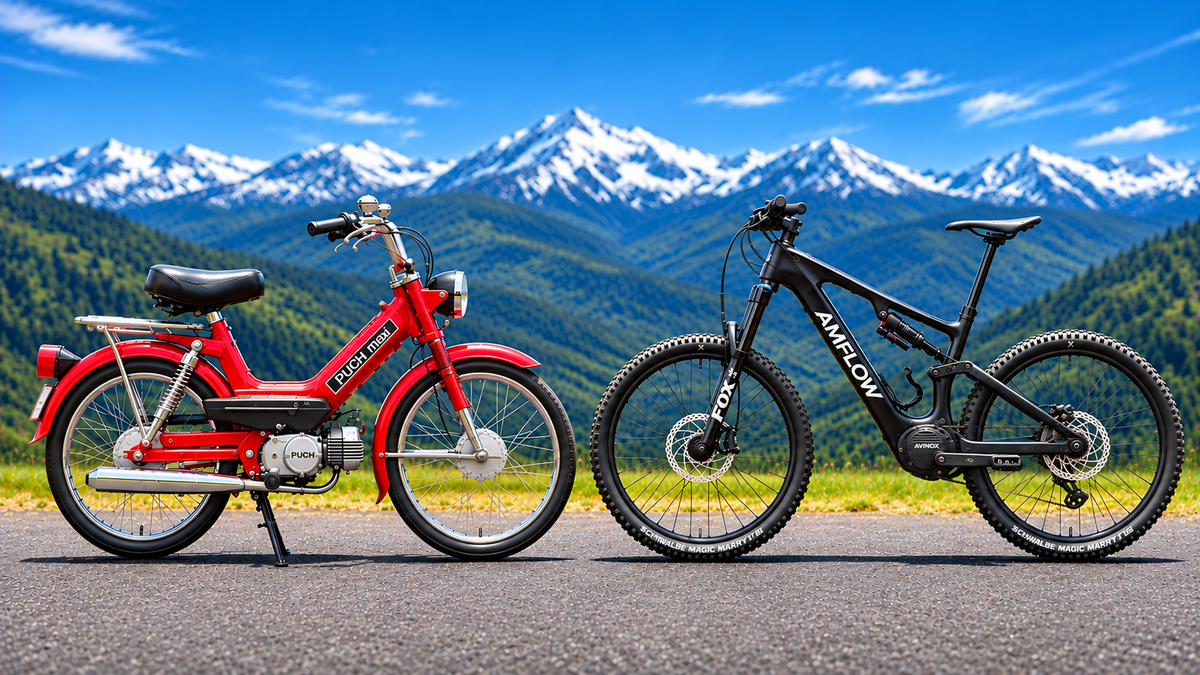
From Watts to Horsepower
It used to be simple: If you wanted to know how powerful a moped, motorcycle, or car was, you asked about the horsepower. With e-mountain bikes, however, manufacturers advertise in watts and Newton-meters. But what do 100 Newton-meters or 1,500 watts actually mean?
At least the power can be easily converted: One PS is equivalent to about 735 watts. An e-MTB motor with a peak power of 750 watts thus delivers just over one PS. At 1,500 watts, that’s already more than two PS.
Newton-meters, on the other hand, describe torque—that is, the motor’s rotational force. Only when combined with rotational speed does this result in power. A motor with particularly high torque is therefore not automatically the most powerful.
The PS Arms Race Among E-MTB Motors
At the top of the pack is the Avinox M2S. Under the right conditions, the drive can reach up to 1,500 watts in Boost mode—equivalent to 2.04 PS. Even the standard-rated 1,300 watts already equates to 1.77 PS. The Avinox M2 reaches a maximum of 1,100 watts or 1.50 PS, while its predecessor, the M1, delivers 1,000 watts or 1.36 PS. Avinox has thus significantly raised the bar within just a few years.
But established manufacturers have also stepped up their game. Specialized’s S-Works 3.1 delivers up to 850 watts, or 1.16 PS. The Mahle M40 is on par with 850 watts. The Specialized 3.1 delivers 810 watts, or 1.10 PS.
Bosch’s fifth-generation Performance Line CX delivers a maximum of 750 watts, or 1.02 PS. The new Shimano EP810 operates at the same power level. The Pinion MGU E1.12 reaches 600 watts, or about 0.82 PS, while the compact TQ HPR60 delivers 350 watts, or 0.48 PS.
This means that even an e-MTB with a Bosch drive has now broken the one-PS mark. The most powerful systems deliver roughly double that.
More PS than the legendary Puch Maxi
Anyone who rode a Puch Maxi in the 1970s or 1980s was on a motorized two-wheeler with about 1.5 PS. The small two-stroke engine had a displacement of 48 cubic centimeters and propelled the moped to the then-standard speed of 25 km/h. Today’s Avinox M2S surpasses that peak engine power by about 36 percent. And it does so with a drive unit that weighs only about 2.6 kilograms, requires no exhaust, and operates virtually silently. Whereas in the past a rattling two-stroke engine was needed to generate one and a half horsepower, today more power is packed into a compact electric motor mounted on the bottom bracket.
However, it still doesn’t quite measure up to the 50-cc mopeds. The legendary Simson S51 delivered 3.7 PS and reached 60 km/h. A typical 50-cc scooter with three to four PS is also more powerful than today’s e-MTB drives. A 125cc motorcycle in the European A1 class is even allowed to produce up to 15 PS.
Six times more power than allowed?
The Avinox M2S delivers over two PS. Nevertheless, a regulation-compliant e-mountain bike equipped with it is classified as a bicycle—not a moped—in the EU. How does that make sense? The explanation lies in a peculiarity of the legal regulations. For a standard pedelec, a maximum rated continuous power of 250 watts is specified. That corresponds to just 0.34 PS. The key term, however, is “rated continuous power.” This does not refer to the highest power a motor can deliver for a short period. Therefore, the motors are permitted to deliver significantly more than 250 watts for brief periods.
For the Avinox M2S, the advertised peak power is six times the legally defined continuous rated power. Bosch’s 750 watts is three times that figure. There’s also a second condition: The motor may only provide assistance while pedaling, and the assistance must stop at 25 km/h at the latest. An e-MTB with two PS therefore does not automatically become a 50-km/h moped.
Two PS Is Not the Same as Two PS
Amid all these impressive figures, one crucial difference must not be overlooked: The peak power of an e-MTB motor is not directly comparable to the rated power of an internal combustion engine. A classic moped delivers its engine power at a specific RPM and requires no muscle power to do so. An e-MTB, on the other hand, provides its maximum assistance only under suitable conditions. These include, among other things, cadence, the power output provided by the rider, the battery’s state of charge, and the drive’s temperature.
How long a motor can actually sustain its peak power is another question. Bosch, for example, points out that the duration of maximum power output depends, among other things, on cooling, the battery level, and the outside temperature. In addition, muscle power comes into play with an e-MTB. A rider who pedals at 200 watts and receives an additional 750 watts from the motor theoretically generates a combined output of 950 watts, or just under 1.3 PS. However, this is true only if both power outputs are applied simultaneously—and before accounting for losses in the drivetrain.
The horsepower figures thus make the motors easier to understand, but they are no substitute for a real-world test.
How many PS does a mountain bike need?
The question arises: Does an e-mountain bike really need two horsepower? Just a few years ago, a peak power output of 500 to 600 watts was considered exceptionally powerful. Today, some drivetrains reach more than double that. This provides enormous assistance on steep climbs but also places new demands on traction, riding technique, and the durability of the drivetrain.
Moreover, more motor power doesn’t automatically mean more riding fun. On technical trails, smooth power delivery can be more important than the highest number on the spec sheet. And if you frequently use maximum assistance, you’ll drain your battery that much faster.
At the same time, this development shows just how much the technical boundaries between bicycles and motorized two-wheelers are blurring. An e-MTB with more motor power than a classic moped has long been a reality.
The good old horsepower helps put this development into perspective. And it makes it clear just how much engine power is now packed into a mountain bike.

About the author: Tobias Gütlin
Note: This content has been automatically translated from German. Please report any incorrect translations.