

Bankruptcy: Dolphin e-bikes are finished
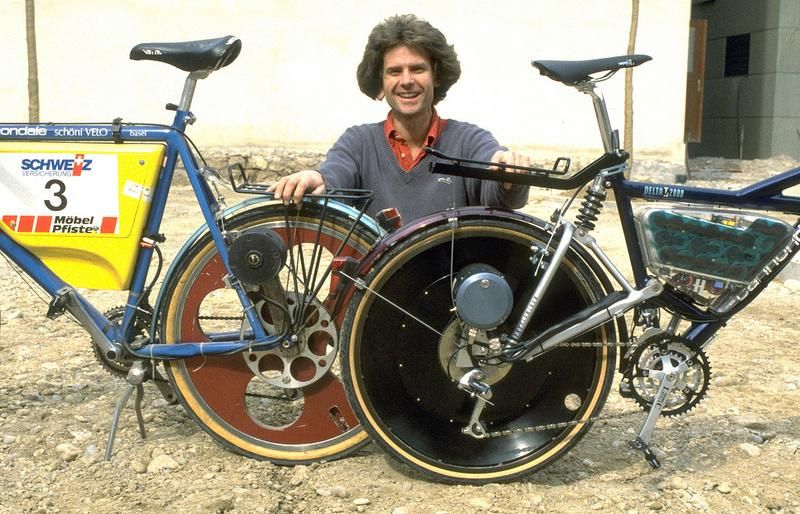
The first pedelec was ridiculed when Michael Kutter brought it into production in several stages in 1990. Now, according to a press release from Extra Energy, the manufacturer of the world's first rideable pedelec, the Dolphin e-bike, is being brought to its knees by a loss of image due to quality defects on the part of the electronics supplier.
"In 1990, the industry wanted to see either a motorcycle or a bicycle. At the time, no one understood anything in between and there were therefore no interested parties for collaborations or investors who believed in the future of electric bikes," says Micheal Kutter. The Basel native did the hardest pioneering work. "I could only give up or do it myself," recalls Kutter today.
First pedelec
Kutter developed a "power split gearbox", in which muscle power and electric power are dynamically mixed in the planetary gearbox of the rear wheel. The EVO gearbox, which was tested as an original prototype in 1990 and later developed further over the years, allows a continuously variable transmission ratio between the pedal cranks and the rear wheel of the pedelec so that, for example, there is hardly any need to shift gears with the existing derailleur in city traffic. This infinitely variable transmission was already "automated" in the original prototype using a sensor and electronics. The sensor measures how much and how fast the rider is pedaling. The electronics ride the correct control. The world's first pedelec was thus built and the category of electric bicycles controlled by the rider's pedaling power, which is now experiencing a worldwide boom, was established.
Born as a principle in 1990, the drive was further developed over many stages: In a research project co-funded by the Swiss Federal Office of Energy, the then non-existent components such as motor control, sensors, gearbox and charger were developed and tested in small series as part of a fleet trial. With the "Dolphin", Kutter then took the first step towards the first series produced in Switzerland in 2000.
Multiple collaborationsIn 2004, Dolphin E-Bike concluded a license agreement with the company swizzbee, which then set up production in Germany."In 2008, the Dolphin was revised in every detail, resulting in the Dolphin Express. A vehicle that became a real scooter replacement for the first time," recalls Kutter. The sensational performance of this model brought the vehicle various test victories in the ExtraEnergy pedelec and e-bike test as well as in the Kassensturz and, after a spectacular hill climb against Olympic champion Fabian Cancellara, it finally became a sales success.
A license agreement with the American manufacturer Currie Technologies, production in China and equipping the Los Angeles Police with the "Dolphin Express" followed in 2008. However, the success soon came to an end due to a serious hidden defect in the electronics developed and produced in Germany. Micheal Kutter recalls: "A two-year production stop with high personnel costs for warranty work was the result of the electronics supplier's defects. A breach of trust that could never be made up for."
Lack of leverage
Kutter puts it in a nutshell: "Without large investments and high volumes, there is a lack of leverage for quality assurance in the supply sector. This makes it very difficult for small manufacturers to industrialize on their own."

Showcased at the Bike Days 2013: the ladies' dolphin.
In 2013, Dolphin E-Bike developed a new women's model with batteries that were even lighter despite their higher capacity, and concluded a production contract for Swiss-made production of the Dolphin. Nevertheless, the bank no longer believed in the promising business model and forced the company to give up the business by terminating the operating loan.
Future in development"The chapter of manufacturing and production is closed for me," summarizes Kutter after decades of activity. Pioneering work that has led to the existence of the pedelec market today. "Our strength lies in development. The tragic events have forced us to return to our core competence. Simon Weishaupt and I now want to focus on this. In future, we want to share our knowledge as a development service provider. We are open to cooperation."
The years of over 100% growth rates in the electromobility market are a thing of the past and the new market situation is leading to changes: Dolphin is not the only company to be hit by this; in January 2014, the Swiss e-bike drive manufacturer Electragil had to announce that it was ceasing operations.
Note: This content has been automatically translated from German. Please report any incorrect translations.