

ABS for the bike is here
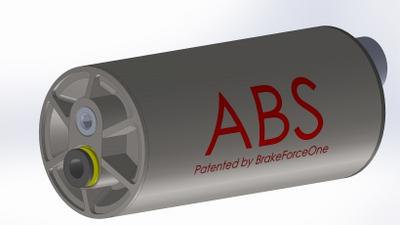
ABS on bikes is a topic that has popped up on the agenda for the last time thanks to brake specialist Brake Force One. The anti-lock braking system has become an integral part of cars and motorcycles, but has so far been non-existent on bicycles, and Brake Force One has yet to come up with anything that is ready for series production in this respect. But the advantages are considerable: uncontrolled lifting of the rear wheel should be made impossible, as should blocking of the front wheel - with the advantage of not crashing, not flying over the handlebars in the evening and achieving shorter braking distances.
"With front wheel ABS, wheel speed sensors monitor the speed of both wheels. As soon as the front wheel threatens to lock up - for example if the brakes are applied too hard - the Bosch eBike ABS regulates the brake pressure and thus optimizes the riding stability and manoeuvrability of the eBike," explains Claus Fleischer, Head of the E-Bike division at Bosch.
In the introductory phase, the first pedelecs with Bosch eBike ABS will be on the road from selected fleet partners from fall 2017 and will be available from retailers from fall 2018. The Bosch eBike ABS will initially only be installed on trekking and city bikes with 28-inch tires. In fleet use, the eBikes are equipped with the Performance Line (Cruise and Speed) in combination with the Intuvia display. The market launch of the ABS combines Bosch with the CMe ABS brake developed by Magura.Now: For the time being, the system will only be used on city and trekking bikes. That's why Ride is calling for another pioneering innovation: Bosch should configure the mountain bike ABS as an option (analogous to E-MTB mode, as a suggestion E-MTB Brake mode) so that it is impossible to cut corners and there are no more annoying braking bumps on busy trails. Flying over the handlebars when overestimating your own riding ability will then have to be dealt with by a future electronic suspension control system.
And: Bosch now has a battery in its quiver that can be seamlessly integrated into the down tube. Until now, e-mountainbike engineers have been challenged to somehow accommodate Bosch's battery packs, which are fixed in size and shape, in the frame. Now bike designers have more freedom with the PowerTube 500, which allows the battery to be removed upwards, downwards or to the side. A two-stage mechanism ensures a high level of safety and easy handling when inserting and removing: when unlocked, the battery clicks about two centimetres out of the frame and can thus be gripped. A safety catch prevents the battery from falling out, which is also optimally protected by the frame. The PowerTube 500 can also be charged directly on the bike. Thanks to recesses on the top, bottle cages or design covers can be attached as required. The surface of the PowerTube 500 impresses with anodized aluminium in black.
The integrated battery has a capacity of approx. 500 watt hours (Wh) and is characterized by compact dimensions (349 x 84 x 65 millimetres) and a low weight (approx. 2.8 kilograms). The PowerTube 500 has a high energy density and is one of the lightest batteries on the market. The new lithium-ion battery is also available in combination with DualBattery: If it is installed horizontally by the manufacturer, the down tube can be used for an additional frame battery or a bottle cage, for example.
Further content on this article
Note: This content has been automatically translated from German. Please report any incorrect translations.