

Driving school for the second time: The gorilla and his trainer
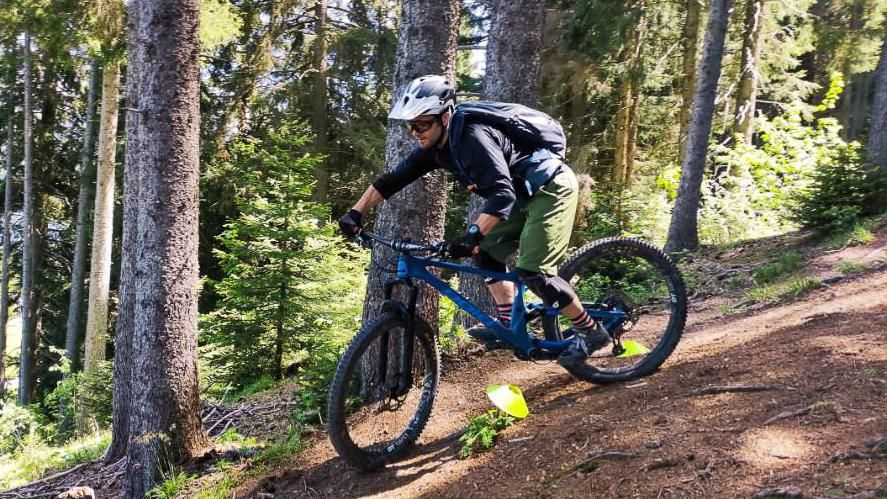
I feel like a fool. I roll over a not too bumpy root field at walking pace, but I'm positioned as if I'm trying to squeeze out the last hundredths of a second on the home straight of a downhill race. And the more exaggeratedly I do the gorilla over the handlebars, the better riding technique coach Dave thinks it is. My position is only good when my hips are higher than my head; at least that's how it feels to me. When Dave then demonstrates how I actually stand on the bike and shows me photos of it, I realize how far my perception is from reality.
This is my second mountain biking lesson, this time a private one. Dave Spielmann, mountain bike guide, guide trainer and managing director of IMBA Switzerland, takes me up the Brambrüesch, one of Chur's local mountains and the entrance to the Alpine Bike Park. My suboptimal position on the bike is already apparent during the first dry runs on the flat. And with that, my hope grows that I can actually improve my riding technique if I manage to overcome the ingrained patterns
.25 years in the wrong position
My routine on the bike is my problem. More than 25 years ago, I pedaled through the terrain on studs for the first time, and in the last 15 years, the proportion of singletrack on my bike laps has steadily increased. I've learned a lot over the years, often learning by falling. And I also seem to have learned a lot of the wrong things. I'm taking up the fight against these mistakes this afternoon and I'm curious to see how long it will last.
The root carpet on which we are now practising is not too steep and doesn't challenge me much in terms of riding technique. But I'm still doing a lot of things wrong: "Chin over the stem! Head down, hips up! Bend your knees less, heels down!" Getting into the right position is much more difficult than riding the short steep section with the 90-degree bend at the end. Like a dancer in front of the choreographer, I vary my movements and ask with my eyes: "How was I?"
The forward position feels strange, but I can feel the stronger grip of the front wheel. What concerns me is that I've gone over the handlebars a few times in my many years on the bike, which I always interpreted as meaning that my center of gravity was already too far forward. I wonder how long it will take for me to make the pike from the gorilla position?
Next, we ride the blue track of the Alpenbikepark. Learner rider in front, instructor behind. "Ride half as fast as you could. That's the area where you learn," Dave tells me. Okay, easy pace, brake more than necessary, hardly slow down on the jumps. After a few hundred meters, Dave stops me for the first time. "Can you ride twice as fast as you were just going?" he wants to know. "Erm, no," I admit. So even slower. Keeping your center of gravity in the right place and your left heel down doesn't get any easier.
The body's memory needs 3000 repetitions
Riding technique courses are experiencing a boom and, according to Dave Spielmann, they are replacing classic tour guiding. "The main segment is 40 or older, has been biking for a few years and wants to develop further. They can afford it and see the added value it gives them." He charges 300 francs for half a day of private lessons. He finds it all the more important that those who give riding technique courses are trained guides and not only ride well themselves, but have also learned how to teach others to do so. It remains to be said that Dave Spielmann has further developed guide training at Swiss Cycling in recent years, which influences his view on this issue.
Another question is up to what age you can learn at all. For Dave, one thing is certain: "You can always do it if you're prepared to practise, because your body memory needs up to 3,000 repetitions to store a new movement pattern. "Of course, the younger you are, the faster you learn, which can sometimes lead to a special dynamic in families who book group coaching with Dave: The father, who knows his bike best, learns less than his wife and his children catch on to the exercises the quickest.
With me, it's just the teacher and me, or the gorilla and his trainer. We are now rolling along a moderately difficult trail, always nice and slow. My position is good until an unexpected obstacle appears, describes the coach, then my upper body moves back again, my hips down and so on and so forth. There is praise too, of course, but I don't always think it's appropriate. Considering how wrong my position on the bike has been for 25 years, I'm still riding quite well, I think from time to time.
Is it all just a midlife crisis?
I keep asking myself why it means so much to me to be good on my bike? Isn't it enough that I can do it properly and find nice single trails everywhere where I can have fun? But there are sections on my home trails that I don't ride - or worse, no longer ride. It's a mixture of naive sportsmanship and rebellion against getting older (some call it a midlife crisis, I call it joie de vivre). In any case, I feel happiest at the end of the trail when I haven't set foot on the ground from top to bottom. I also just find it interesting to see what I can still achieve in terms of riding technique.
The next trail section is much more challenging, with a series of steep, tight bends. I don't pass them super smoothly in the Gorilla, but I get around and don't think about getting off. Dave encourages and cheers from behind. Again and again I fall back into the old pattern, which still feels more natural, but the advantages of the new position outweigh the disadvantages. I certainly wouldn't have ridden all those hairpins at the first attempt, as I do that afternoon.As we finally roll through Chur towards the station, I feel a little like I've just passed my driving test. Have I really found the key to being able to ride steeper, narrower, more blocked trails than I've been able to so far? Dave reminds me that the practicing is only just beginning and goes through the key rules with me one last time, which will be my mountain bike mantras from now on: Head down, hips up, heels down. Not forgetting the gorilla I'm supposed to be.
Three days later, I want to know how my new riding style will affect my favorite descents at home. I roll resolutely towards the first key section. I've ridden it several times before, always slightly out of control and always descending the last few times. Now I have my chin in front, my elbows out, I roll in optimistically, not wanting to go too fast. And descend again. Two more attempts lead to a crash and the realization that I'm not a new person on the bike yet. Of course, that doesn't mean that the riding lesson with Dave didn't help. Maybe I need my instructor on the back wheel to believe that I can ride a difficult section.
Dave's reaction to this setback: "You don't learn in the zone where you have to give 100 percent."
Further content on this article
Note: This content has been automatically translated from German. Please report any incorrect translations.