

Drone regulation: Get your pilot's license for a moment
Who is affected?
While the operation of drones (Unmanned Aircraft Systems, UAS for short) has been regulated in the EU since December 31, 2020, it was still possible to continue flying "wild" in Switzerland. Although there were already rules in place, it was not necessary to obtain a certificate of drone knowledge and the relevant laws. However, since January 1, 2023, the EU regulations for drone flights have also applied in this country.
Private and commercial drone pilots are required to register and pass an online test. Exempt from this regulation are those who fly drones weighing less than 250 grams, but only if they do not have recording devices such as cameras or microphones on board - in other words, very few. The registration therefore also applies to users of camera drones weighing up to 250 grams; above this and up to 25 kilograms, an online test must also be taken.These drones belong to the open category and are divided into the subcategories A1 (250g), A2 (4kg) and A3 (25kg). Drones in the open category must also have a class marking (C0, C1, C2, C3, C4). For example, the Dji Mavic 3 is C1-classified and belongs to category A1 with its weight of 895 grams. Drones without a class marking fall into the transition category, where slightly adapted rules apply. These apply until the end of 2023, after which it could become more difficult to operate drones without class markings.
Registration and testingRegistration for the operation of drones in the open category is carried out via the UAS registration platform on the FOCA website (Federal Office of Civil Aviation). By law, drone flying is only possible in Switzerland from the age of 12, in other European countries only from the age of 16.
After registering and setting up a user account, you can start the course and exam straight away. Even if data such as ID/passport number or proof of insurance can be stored in the user account at a later date, they are mandatory for the exam. Speaking of insurance: personal liability insurance that covers at least one million francs in the event of material damage or personal injury while flying despite all due care is a prerequisite.The course with subsequent knowledge test consists of the following eight modules: Aviation regulations, Air safety, Human performance, Operational procedures, UAS general knowledge, Privacy/data protection, Insurance and Security. Each module begins with a learning block, followed by a total of 36 exam questions with multiple-choice answers.
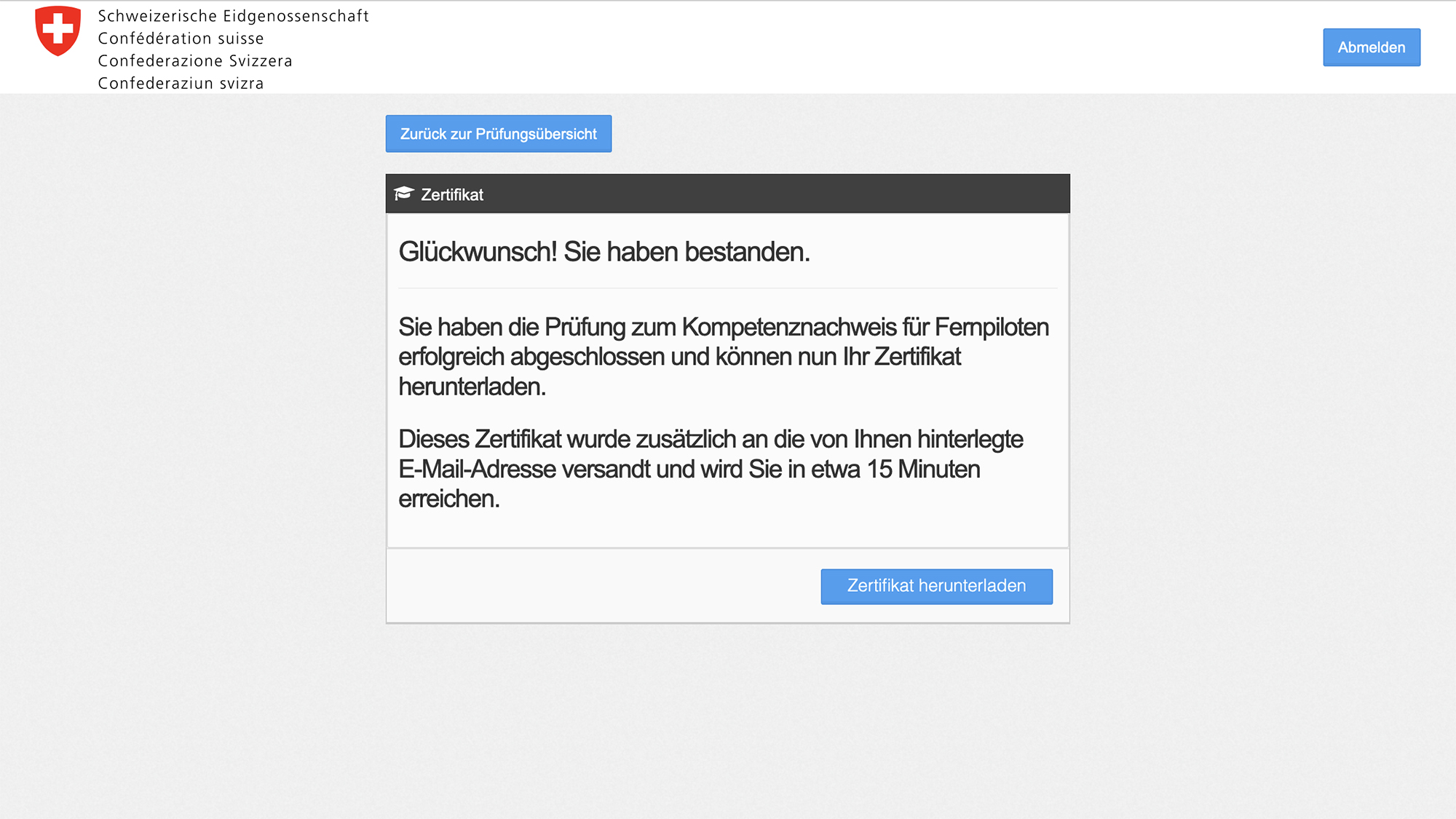
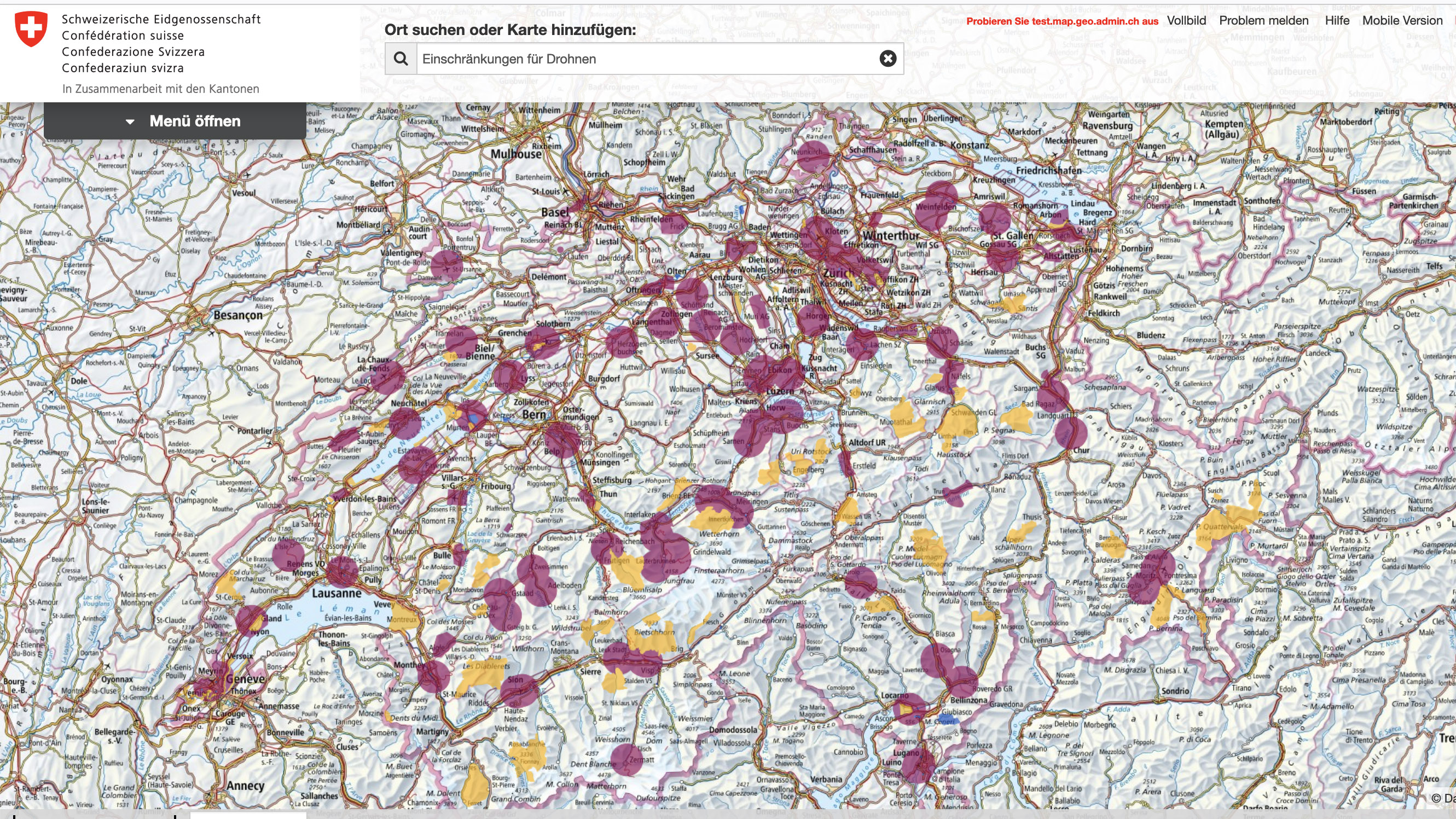
The exam is passed if more than 75 percent of the questions are answered correctly. However, those who complete the learning blocks attentively should have no trouble answering them correctly. The whole thing can be completed in around two hours. The certificate can be downloaded immediately after passing the test and will also be sent to the email address provided.Being well informed is half the battleOnce you have passed the test, you don't have to be able to recite every single rule by heart. The most important rules, such as maximum altitude, flying around and over people, no-fly zones, privacy and physical and mental fitness, should nevertheless be familiar. It is therefore important to plan ahead and obtain specific information before a flight, know the sources of information and, if necessary, ask the relevant authorities, landowners or private individuals.
If you want to fly your drone abroad, you should definitely familiarize yourself with the relevant legislation at your destination. The EASA website provides a list with links to the most important information on the EASA member states, which include 27 European countries plus Iceland, Norway, Liechtenstein and Switzerland. In these countries, the operation of category A1/A3 drones with the EASA certificate is permitted.
At present, no practical test is required for certification. However, drone flights are not recommended without the necessary skills. Obstacle-free areas such as harvested crop fields and meadows are the best places for newcomers to learn how to control the small and agile aircraft. In the worst case scenario, the drone crashes into the open field and not into trees, rocks or water. Good control brings safety, is much more fun and the quality of filming increases with your own skills.Links on the topic
bazl.admin.ch/bazl/drones/transition category


Note: This content has been automatically translated from German. Please report any incorrect translations.