

Syntace Evo6: (Another) new hub standard
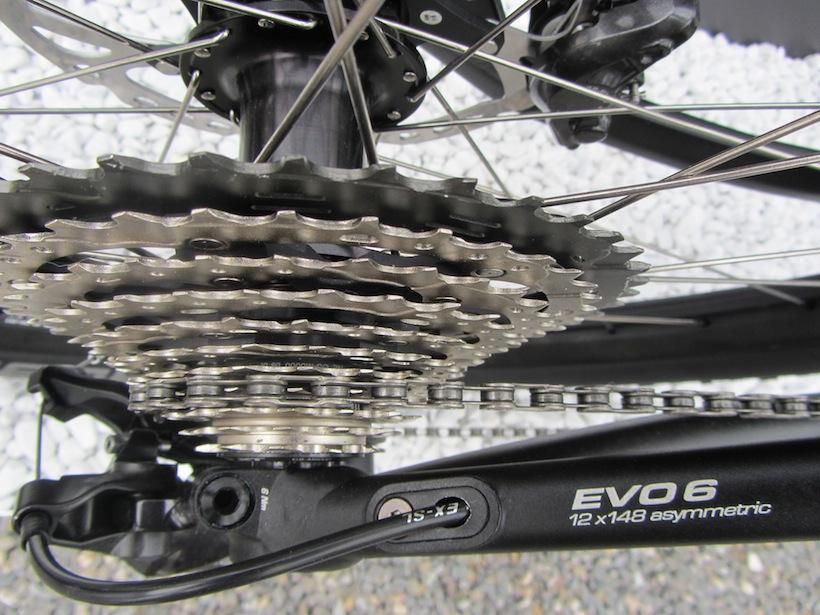
With the Boost standard, the hub is 6 millimetres wider than the X-12 standard of 142 millimetres. These 148 millimetres are achieved by sliding the left and right hub flanges outwards by 3 millimetres. This results in a flatter spoke angle and therefore more rigidity in the wheel.
Syntace is not satisfied with this and presents its own solution for 148 millimeter wide hubs: The 6 millimeters are only added to the right hub flange, effectively relieving the drive side on the rear wheel. The Syntace makers say: "The result is a fully symmetrical, lightweight rear wheel with higher load-bearing, identical tension of the right and left spokes." This requires a Boost crank with a chainring offset of 3 millimetres to the outside for the new standard, while the sprockets/cassette slide 6 millimetres to the right. The rear wheel/rim must be spoked asymmetrically to achieve an almost symmetrical spoke position.
Own solution
With the EVO6 frame standard, Syntace presents a proprietary solution. This means that only suitable frames, in this case the new Liteville frames presented at Eurobike such as the H-3 or 101, are compatible. The rear triangle of these frames is offset by 6 millimeters. For the first time, Cannondale has shown such a concept with the F-Si frame in order to achieve more stiffness in the rear wheel.

Syntace / Liteville is now showing the adaptation of this concept to an installation width of 148 millimetres with Evo6. With the X-12 standard, the flanges are positioned at 34 / 20.5 millimetres, with the Boost standard at 37 and 23.5 millimetres, and with Evo6 at 31 and 29.5 millimetres (approximate flange positions). This Evo6 position of the flanges enables almost symmetrical spoking of the rear wheel rim. As with the X-12 dimension, other manufacturers can access the Evo6 frame standard.
Note: This content has been automatically translated from German. Please report any incorrect translations.