

Test: Rocky Mountain Altitude compared to the Altitude Powerplay
Equipment and weight
Before the two bikes are allowed to prove themselves in the trail arena, however, they are thoroughly scrutinized.
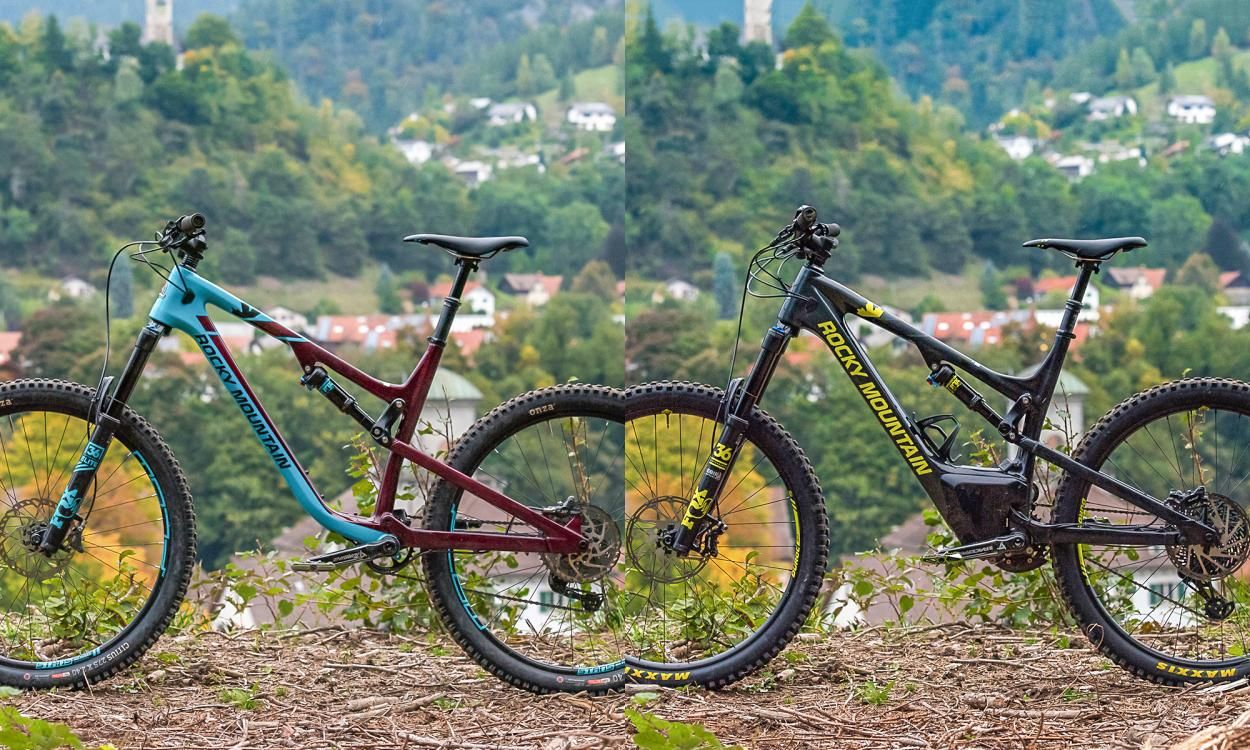
Rocky Mountain "Altitude Carbon 70"
As the name suggests, the bike has a carbon frame with adjustable geometry (RIDE-9TM). At the front is a Fox "36 Float EVOL FIT4 Performance Elite" suspension fork with 160 millimetres of travel. At the rear, 150 millimeters of travel is available, which is handled by a Fox "Fox Float DPS EVOL Performance Elite" shock. The seatpost, the Fox "Transfer Performance Elite", also comes from Fox. The gears (Shimano XT 11-speed, front 32 teeth, rear cassette 11-46 teeth) and brakes (Shimano XT 180 millimetres) are from Shimano. The bike also features many RaceFace and RockyMountain attachments.
Onza supplies the black gold in the form of grippy tires: A Citius "EDC RC²45a" in 27.5 x 2.4 inches at the front and an Ibex in the same design and dimensions at the rear.
Including pedals, the enduro bike weighs in at 13.5 kilograms.
Rocky Mountain "Altitude Powerplay 70"
A carbon frame with adjustable geometry is also used here. A look at the geometry data of the two bikes is exciting. They are almost identical. At first we suspect a misprint in the specifications, but on closer inspection we discover one or two differences, for example the length of the seat tube is different, which is of course due to the electric motor. Otherwise, however, the bikes are equipped with the same geometry.
The fork, shock and dropper post of the Powerplay 70 also come from Fox. Braking is provided by the Sram GE (200 millimeter disc) brakes, which were specially developed for e-bikes. The wide 40 mm rims are called Sun Düroc 40, which are fitted with Maxxis "Minion DHF WT EXO 27.5 x 2.5" tires.Of course, this bike also has to be weighed before it can enter the ring: the display stops at around 23 kilograms - including pedals.
Same geometry, same handling?
The matching geometry data of the two bikes impresses us. But we're not riding the bikes on paper, we're still riding them off-road. So off we go on the test lap. It starts with a short flat section and a longer but steady climb with two short but steep ramps towards the end. Once you reach the top, a slightly sloping trail littered with roots branches off from the forest road, which gets rougher the longer it goes on. It is spiced up with off-cuts, natural berms and a short high-speed section - in short, a trail with everything that makes a mountain biker's heart beat faster.
The Altitude on the circuit
The Altitude, powered by pure muscle power, is the first to prove itself. At 13.5 kilograms, the bike is certainly no lightweight, but what enduro bike is? What's more, a rider with some basic fitness can easily ride this bike up the mountain. With the rear shock closed, the Altitude climbs one meter of altitude after another very comfortably and calmly. The stiff carbon frame converts every watt of power into propulsion, allowing us to quickly gain altitude and soon plunge into the downhill.
Shock up, saddle down, brakes off, mouth corners back - the simplest formula for happiness. The Altitude is in its element here. Neither the roots nor the steep drops upset it. Only when braking hard on gravel or loose ground does it start to wobble a little, but it always remains controllable. The Altitude is undoubtedly a fun bike that has matured over the years, period.
The power play on the circuit
Still pumped full of adrenaline from the lap on the Altitude, we sit down on the Powerplay. With the extra thrust under our butts, we would only get bored on the uphill - even with a gradient of over 20 percent, of course. Without further ado, we adapt the route slightly. In other words, we ride the actual downhill section both up and down. Power to the max and off we go. Even as experienced mountain bikers, we are always amazed at the extra power from the battery.
In the flat starting section of the route, the two bikes are confusingly similar in terms of riding position. The additional power is not so relevant here. However, as soon as we turn off the forest road onto the singletrail, the difference in performance is striking. A climb no longer fails due to fitness, but at most due to your own riding technique. Operating the control unit is simple and self-explanatory, and we like that. We are glad to have the support of the motor in "pedestrian mode" on the uphill sections.On reaching the top, we plunge straight back into the descent: shock up, saddle down, brakes off, mouth corners back. The Powerplay also performs very well downhill and is a real grip monster when braking and cornering. Overall, it rides much more smoothly downhill than the Altitude, but the playfulness and liveliness fall by the wayside - but fortunately not the fun factor.Conclusion: Same-same, but different
Yes, the two bikes have a lot in common, but despite identical geometry, they are very different to ride. Logically, the "weight" factor is the main difference here. This is most noticeable during the photo shoot, where we change bikes almost within seconds. This is where the biggest differences are noticeable. The liveliness of the Altitude is just as inspiring as the sheer power of the Powerplay. So no matter what the potential buyer decides, they will certainly not be disappointed. However, we cannot subscribe to the statement that the e-mountainbike and its muscle-powered counterpart ride the same way.


Note: This content has been automatically translated from German. Please report any incorrect translations.