

Test: Rocky Mountain Altitude Powerplay Carbon 70 - strong and hungry


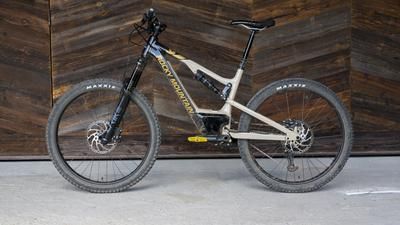
The Altitude Powerplay has 170 millimetres of travel at the front and 160 at the rear. The frame is equipped with Rocky's Ride 4 system, which allows four different linkages of the shock and adjusts the geometry. The bike was tested in the slack position, the variant with the lowest bottom bracket, ideal for an aggressive riding style and therefore suitable for a potent E-Enduro.
What makes this product stand out:
- Removable, larger battery, smaller motor
- Display integrated in the top tube (vs. iWoc from before)
- Industry-leading torque of 108 Newton meters
Statement from: Corinne Iten, Marketing Manager Bike, Chris Sports AG
Special features
- Dyname motor
- Ride 4 adjustment system
- Bolted shock mount
- Display in the top tube
- End stop for suspension fork on the down tube
- High pivot system
On the flat
This bike doesn't need a sporty riding position. Thanks to the powerful motor, an upright position is quite comfortable. With the highest support level "Ludicrous", you can reach maximum speed with just a few turns of the crank. Yes, 108 Newton meters of power is noticeably a lot. Without support, the Altitude rolls slowly, and the downhill tires with Cush-Core inserts really slow you down. The steering behavior is a little sluggish on flat terrain, which is due to the flat steering angle of 63.5 degrees.
Up the mountain
Powerplay is the motto uphill. The motor develops the most power at around 85 pedal revolutions per minute. You don't need any, but you do need a lot of puffing to maintain the cadence over a longer period of time. On forest roads, the speed is so high that the wind almost drowns out the engine noise. In bends, you usually have to stop pedaling for a short time, as the bike goes fast and at an angle and there is a risk of the pedals hitting the ground. The same applies up rough trails: the soft rear end dives in a long way and you quickly get "stuck" on the ground. The balanced geometry and the powerful yet easy to control motor make the Rocky a very good climber - much better than you would expect from such a long-travel bike. However, so much power also has its limits. During the endurance test on a very steep asphalt and gravel track - 90 rpm and 25 km/h continuous power for more than 15 minutes - the motor is brought to its knees. It overheats and only provides little and jerky support. This is unexpected, but to be honest it has to be said that no other motor has ever been able to master this ramp at an average speed of 25 km/h before. It always stopped at around 22 km/h.
According to Rocky Mountain, no overheating of the motor could be detected in the subsequent evaluation of the error codes. However, the pre-production bike had a problem with the torque sensor, which caused the "stalling or bobbing". The problem with this sensor has already been rectified on the series models.
Downhill
The Altitude plays its trump card on the descent. The Fox fork and the shock from the same company harmonize perfectly. The suspension is super-soft at the beginning, in the middle range it has good counter-pressure and hardens very late. It rarely releases the entire stroke, not even when you're banging through deep compressions at high speed. Even if these reserves are hardly used, you never get the feeling of having too little travel. On the contrary, the bike really soaks up the ground and it's amazing that often only two thirds of the rear travel is used. The Rocky holds its line faithfully, but requires some physical effort. Once you get the hang of it, it rides very playfully
.Conclusion
The Rocky Mountain Altitude Powerplay Carbon 70 is very powerful, but it also draws a lot of power. The motor overheating was a problem with the pre-series. Fortunately, because the bike's riding performance was more than convincing. It climbs as well as a Canadian brown bear and downhill you can tell that the developers are at home not far from the Whistler bike park: Pure riding fun.
Recommendation
If you like jumping or riding trails with high berms, you are well advised to adjust the setup with five to ten percent more sag. This provides the necessary counterpressure.
Specifications
| Frame material: | Carbon |
| Price: | CHF 10'299.00 (from CHF 7999.00 in aluminum) |
| Weight: | 25 kg (frame size M, with pedals) |
| Suspension travel: | 170 mm front / 160 mm rear |
| Engine: | Dyname 4.0 Mountain Bike Drive, 250 W, 108 Nm |
| Battery: | Rocky Mountain, 720 Wh |
| Suspension fork: | Fox 38 Float Evol Grip Performance Series |
| Suspension strut: | Fox Float X2 Performance |
| Shift: | Shimano Deore XT |
| Brakes: | Shimano Deore XT, 4-piston, 203 mm |
| Crankset: | Race Face Aeffect Cinch |
| Wheels: | Rims: WTB ST i30 TCS 2.0 Hub V: Rocky Mountain Hub H: DT Swiss Hybrid 370 |
| Tires: | V: Maxxis Assegai 3C Maxx Grip DD, 29 x 2.5 WT H: Maxxis Minion DHR II 3C Maxx Terra DD, 29 x 2.4 WT |
| Saddle: | WTB Volt Race 142 |
| Saddle post: | Race Face Aeffect R dropper, 150 mm |
| stem: | Rocky Mountain 35 AM, 40 mm |
| handlebars: | Rocky Mountain AM, 780 mm, 38 mm rise |
Geometry
All data here: Link
Manufacturer
Test report published in issue no. 80 of Ride magazine.
Further content on this article


Note: This content has been automatically translated from German. Please report any incorrect translations.