

Test: Specialized Turbo Kenevo Expert - Freeriding under power
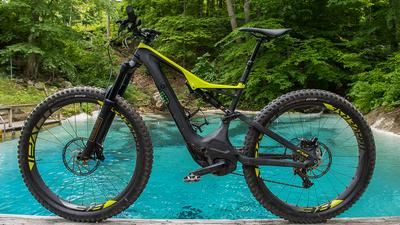
Optically, the Kenevo is a stunner - literally, because the e-freeride bike with its 180 millimetres of suspension travel at the front and rear looks really massive. It doesn't seem to get rattled. The FSR rear triangle together with the TTX22M steel spring damper from Swedish suspension specialist Öhlins ensures this. At the front, an old acquaintance works in the latest version - the Lyrik RCT3 in the Solo Air version.

Whether in Black/Cali Fade/Hyper or Gloss Black - the Turbo Kenevo is an eye-catcher.
While the suspension elements are impressive in name, the rest of the equipment is also impressive. The dropper post, of all things, stands out among the far more striking parts: Although it also bears the name "Command Post", Specialized's own dropper post, which is installed here, bears the suffix "WU". The special thing about it is that the saddle can be mounted as normal, but as soon as it is lowered, it tilts backwards, similar to the saddle position of a downhill bike.
Because the WU mechanism tilts the saddle nose upwards by 14 degrees when the seat post is lowered, the rider has more freedom of movement over the rear of the saddle - just like on downhill bikes. When the seat post is extended, you have all the advantages of a conventionally mounted saddle for pedaling.

The Command-Post WU - an innovation that is sure to be a hit with enduro bikes in particular.
For the drivetrain, Specialized relies on Sram's GX drivetrain with "one-click shift" shifters. Power is transmitted to the wheels via a 32-tooth chainring and an 11-42-tooth cassette. These consist of in-house Boost hubs with 24 spokes at the front and 28 at the rear, DT Swiss spokes and Roval Traverse rims with a hookless profile and 38 millimeter rim width. The wheels are fitted with the new and robust Butcher tires with Grid carcass and grippy Gripton rubber compound. The tire width of the 27.5-inch plus-size tires is 2.8 inches.
No mountain track - no problem!
No, we didn't have the bike on the scales, but it is by no means a lightweight. Nevertheless, the way to the downhill sections is tackled by pedaling. The weight is immediately forgotten and the latest generation turbo motor purrs quietly under the pedal revolutions. This is very steady and even in turbo mode with sustained power output.
The position on the Turbo Kenevo is surprisingly good for riding uphill, even if you wouldn't expect it on this bike. This means that even longer climbs can be ridden without back pain, even if you do so at a sporty pace. Steeper and more technical climbs can also be tackled with ease on this bike. Riding technique is the limiting factor here rather than your own strength or the bike.
The battery indicator shows a full ten bars at the start of the first test ride. One corresponds to ten percent battery charge. From the start to the trail entrance, there are around 300 meters in altitude, mixed with flatter and steeper sections. At the top, the battery level still shows nine bars. Have I really only used up ten percent? I'm not quite sure, but even after two more ascents and descents, the display only shows one bar each time. That sounds promising and like an e-bike tour with a lot of elevation gain on just one battery. But 3,000 meters of altitude? That's quite a lot. I wasn't able to test it, but even if you can manage 2,000 meters of altitude with a rider weight of around 75 kilograms, it's a great value. I can't guarantee these figures, but if possible we will test the battery performance of the Kenevo again in more detail. What is certain, however, is that the motor and battery work perfectly together.
Only flying is more beautiful
Downhill, the test terrain offers everything from flowing to rock-hard trails with natural rock gardens, roots and decent jumps. It is noticeable from the first few meters that the Turbo Kenevo handles very well. High speeds are therefore no problem at all. In addition to the low and well-balanced center of gravity, the rear suspension also ensures good traction. The braking holes in the numerous berms are literally ironed out. The new Butcher Grid tires also make a good impression. They offer plenty of grip and high puncture protection.
The Kenevo also likes crisp descents, roots and rocks: its suspension can really take a beating. When the terrain gets rough, you sometimes get the feeling that the bike bounces a little more between the rocks than a non-motorized bike. However, I've also noticed this with other e-mountainbikes and it's probably due to the lower additional weight - so it's definitely not a "Kenevo problem", but a characteristic of e-mountainbikes. To be fair, it must also be said that the differences between e- and normal freeride bikes are small.

Technical, rough or fast? No problem for the Kenevo. Photo ©Alex Quesada
The Kenevo is super smooth, even when it rumbles under the wheels. Anyone who thinks the bike is sluggish is wrong. For an e-mountainbike with such a smooth ride, it's a lot of fun and, above all, it jumps. The jumps in the bike park pose no problems for the Turbo Kenevo. The bike is very stable in the air, and yet it can also be whipped - i.e. turned sideways. If a flight goes a little too far, the bike catches you perfectly. But be careful! You need to have the strength to hold on to the handlebars, otherwise even the best bike is useless.

If you can't jump that accurately yourself, you'll just have to get colleague Chris from MTB-News to do it for you ;)
Conclusion
If you want to indulge in downhill sports but don't have a cable car or shuttle options nearby, the Turbo Kenevo will make a great friend. It rides well uphill and impresses with its good power delivery and powerful battery. Downhill, it is a grenade that is easy to maneuver and jump despite its high weight. At CHF 7,299.00, the Kenevo is no bargain, but to be honest, a good enduro or downhill bike costs no less, or often even more.
www.specialized.com/turbokenevo
Further content on this article
Note: This content has been automatically translated from German. Please report any incorrect translations.