

Trek without carbon, but with integrated fitness
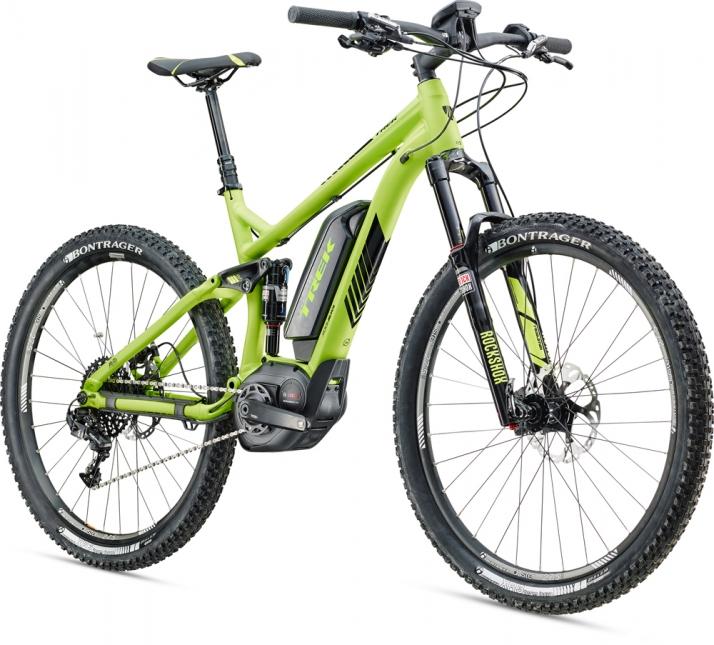
Full-suspension e-mountainbikes are on the rise. Trek is also focusing on the soft electric plane, but is taking a competitive approach. The US mountain bike manufacturer is taking a close look at the current e-bikes on the market. Many are based on an existing mountain bike model, but are far from it in terms of riding performance.
Trek is trying to incorporate all the experience from its full-suspension range into its new E-Fully, the Powerfly+ FS. The motor mount, which is very slim on the Powerfly+ FS, is already striking. Trek has also kept the chainstays fairly short at 465 millimetres by positioning the main pivot point of the rear triangle slightly above the 250 watt Bosch motor. This is protected by a specially developed cover, but can do more than just that.The motor also requires the first change compared to the "normal" Fully models. The "full floater" system to which the shock is normally bolted is no longer required. Trek's suspension specialists have also had a hand in the linkage of the shock. As an e-bike has different requirements to a normal mountain bike, the suspension characteristic of the Powerfly+ FS is completely different to that of Trek's "normal" mountain bikes. It is much more progressive in order to compensate for the influence of the motor. This allows you to ride with relatively little air pressure in the shock. Trek wants to achieve a fine response in the upper suspension travel range, but more counter-pressure in the lower range. Nevertheless, the 120 millimetres of travel should still be fully usable.


Keeping the balance
The weight of the Powerfly+ FS is around 21 kilograms. The additional weight comes from the stronger frame construction, the motor, the battery and other small parts. It is important that the weight is well balanced. Trek calls this "Balanced Geometry", which embodies the optimum combination of comfort and dynamics and is designed to give the rider the best possible ride performance.
To ensure that the Powerfly+ FS comes as close as possible to its non-motorized brother - the Fuel EX - in terms of handling and smoothness, the centre of gravity is kept low. The down tube is also low in relation to other e-bikes and gives its owner enough legroom for crisp off-road rides.
Despite the fact that Trek's new e-bike flagship is intended to set new standards in terms of riding performance, their marketing department does not primarily see trail bikers as the target group. The Powerfly is intended to appeal to people who are no longer able to go on easy tours. However, it should also appeal to people who are looking for a top bike for everyday use that is more than just suitable for off-road riding. That is why the Powerfly models are prepared for mounting lighting systems, for example.
The top-of-the-range FS 9 model, equipped with Shimano XT brakes and a Sram X1 groupset, is also the only model with a Vario seatpost - a Rock Shox Reverb with an external cable. The frame is not primarily designed for dropper posts with internally routed cables. If the mounts and internal cable ducts for a fixed lighting system are not needed, they can be reused for the internally routed cables of these dropper posts - but at your own expense.The Trek Powerfly+ FS is available from CHF 3,425.00. The top model FS 9 rolls out of the bike store for 4,628.70 francs - figures without guarantee.
Model from the 3D printer
In order to check the compatibility of all parts, including the electric motor, and to fine-tune the details, Trek prints a true-to-original frame using 3D printing technology. An engineer from their development department reveals that the bike had to be provided with warning labels. The risk of an employee sitting on the unrideable model would have been too great.

The true-to-original frame from the 3D printer.
Trek's use of the 3D printer is probably not just for model purposes. It can also be interpreted as a test to produce ready-to-ride frames from the printer in the future. Although this interpretation is still a dream of the future, it will become a reality in frame and parts construction in the indefinite future - whether at Trek or other manufacturers.
Suitable Ride Brandguides
Note: This content has been automatically translated from German. Please report any incorrect translations.