

WaldSchweiz wants money for trails - What's behind it?
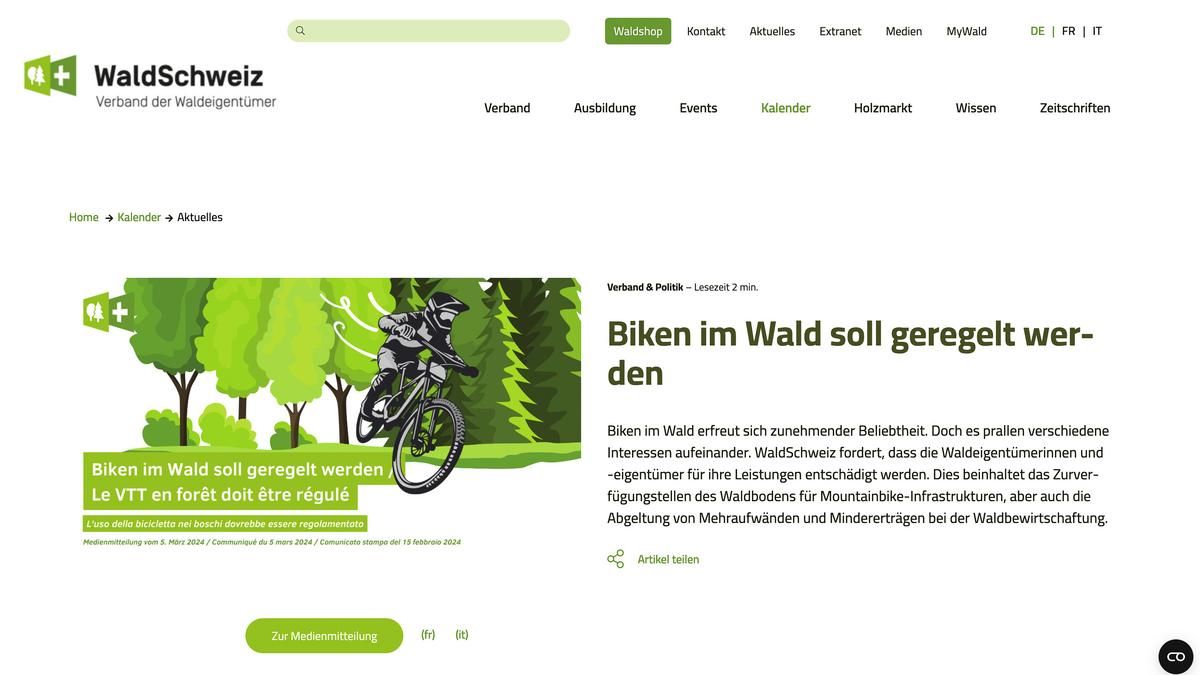
1 - 2 francs per running meter and year. This is the starting value proposed by WaldSchweiz to compensate forest owners for allowing mountain bikers to use trails on their land. The model is reminiscent of the payments that landowners in ski resorts receive so that their land can be used as a ski slope in winter. However, there is a fundamental difference: ski slopes are generally operated commercially. The controversial bike trails in Switzerland are generally used for local recreation and not to create added value for tourism.
So now WaldSchweiz, as the spokesperson, is putting a price tag on the forest. 1 kilometer of trail costs 1000 to 2000 francs per year. This is the basic contribution to forest owners, according to the association's position paper "Biking in the forest". Additional costs and reduced revenue from bike trails should be added to this. The total compensation is therefore even higher.
But how is the basic contribution calculated? Dominik Brantschen is a research associate at the association and co-authored the paper. He does not provide the arithmetic derivation of the compensation amount, even when asked. However, he cites the "recreational value generated" for those who use mountain bike trails or single trails in the forest. How this is calculated can be distilled with a great deal of effort from a publication by the Federal Office for the Environment. "Wert der Erholung im Schweizer Wald" is the title of the 46-page work, which puts the total recreational value of the Swiss forest at CHF 3 billion per year.
Brantschen explains that the proposed compensation is only a fraction of the recreational value. The press release from WaldSchweiz states that the 3.5-kilometre-long Antennentrail in Zurich generates recreation worth several hundred thousand francs per year with 60,000 descents. The recreational value is a starting point for calculating the compensation for forest owners. Brantschen explains: "The more frequented and therefore the higher the recreational value, the more specifically the infrastructure is designed for bikers and the greater the impact on the forest floor with earth movements, buildings and so on, the higher the compensation should be."
The main focus is on newly built bike trails
After all, WaldSchweiz is not demanding compensation for every meter of forest trail used by mountain bikers. "The focus is clearly on newly built or newly legalized MTB trails and MTB tracks, as defined in the information sheet," specifies Brantschen, "MTB trail infrastructure that requires a permit from the authorities and counts as a non-forestry small facility under forest law." In the case of existing trails, the additional expense and reduced yield from intensive use must be considered, Brantschen continues.
Compensation is already common practice for new constructions, although there are neither fixed procedures nor amounts for compensation. In principle, it is understandable that private individuals, corporations and other non-state forest owners receive money for making their land available for bike trails. The question then is whether only the use of forests for mountain bikes should be compensated. WaldSchweiz's position paper is entitled "Biking in the forest". Other uses are not mentioned. Dominik Brantschen explains that, in the opinion of WaldSchweiz, bike trails built in the forest go beyond the legal right of access. Walking on foot is logically within the right of access. Where exactly this ends remains unclear. However, Brantschen explains that recreational use in general must also be discussed.
What is the effect of this price tag that WaldSchweiz has put on the Swiss forest? Will it make trail projects unaffordable? Or are bike trails suddenly a profitable business? And how do those representing the mountain bike community feel about the forest owners' proposal?
The reaction of MTB organizations and trail building companies
The reactions are extremely cautious. Of course, all representatives of mountain bikers are aware that they are not doing them any favors by tearing up the position paper from WaldSchweiz. First they see the positives. At the request of Ride, SwitzerlandMobility wrote: "First and foremost, we see the positioning of Swiss Forestry as an offer for constructive dialog at local and regional level."
Imba Switzerland responded together with Swiss Cycling. They welcome the fact that WaldSchweiz recognizes the needs of mountain bikers, that riding on signposted trails is possible in principle, that forest owners are encouraged to be open to steering measures and that even the legalization of unofficial trails is being considered. The two organizations are critical of the focus on mountain bikers. "The pressure to use fields and forests comes from all recreational activities, be it pedestrians, horse riders, mushroom pickers, hunters or mountain bikers. We therefore advocate a comprehensive view of nature as a place for sport and adventure."
The majority of trail construction companies did not respond to Ride's request - or stated that they did not have the capacity to deal with it in sufficient depth. One thing is clear: those who build mountain bike trails have little interest in positioning themselves on this political issue. Only Dave Tschumi from Vast Trails takes a stand. After citing roughly the same positive points as those mentioned above, he writes: "Some of the wording is very one-sided and polarizing. For example, the demand for annual financial compensation. In our view, this is not the only solution, as non-monetary compensation can also be agreed (e.g. forest maintenance, compensatory and offsetting measures, rights of way in return, etc.)." Tschumi also points out that the compensation in the proposed amount represents a fraction of the construction and maintenance costs. This could be different for existing paths.
What the Swiss Forestry demand will achieve
The question remains as to what effect the Swiss Forestry position paper will have. It is significant that it is also written as a "leaflet for forest owners", i.e. as direct instructions on how they can argue in negotiations. However, Brantschen admits that the proposal is not binding. It is up to the members of WaldSchweiz to decide how much compensation they want or whether they want to forego it.
The position paper leaflet from WaldSchweiz has startled certain people, as can be heard from the official reactions. However, the publication is not a game changer. Some forest owners are already being compensated for making land available. Others do not and do not have to do so even after the official demand from Swiss Forests.
Further content on this article


Note: This content has been automatically translated from German. Please report any incorrect translations.