

From Skepticism to Rejection: What Associations Are Saying About the Sport Schweiz Study
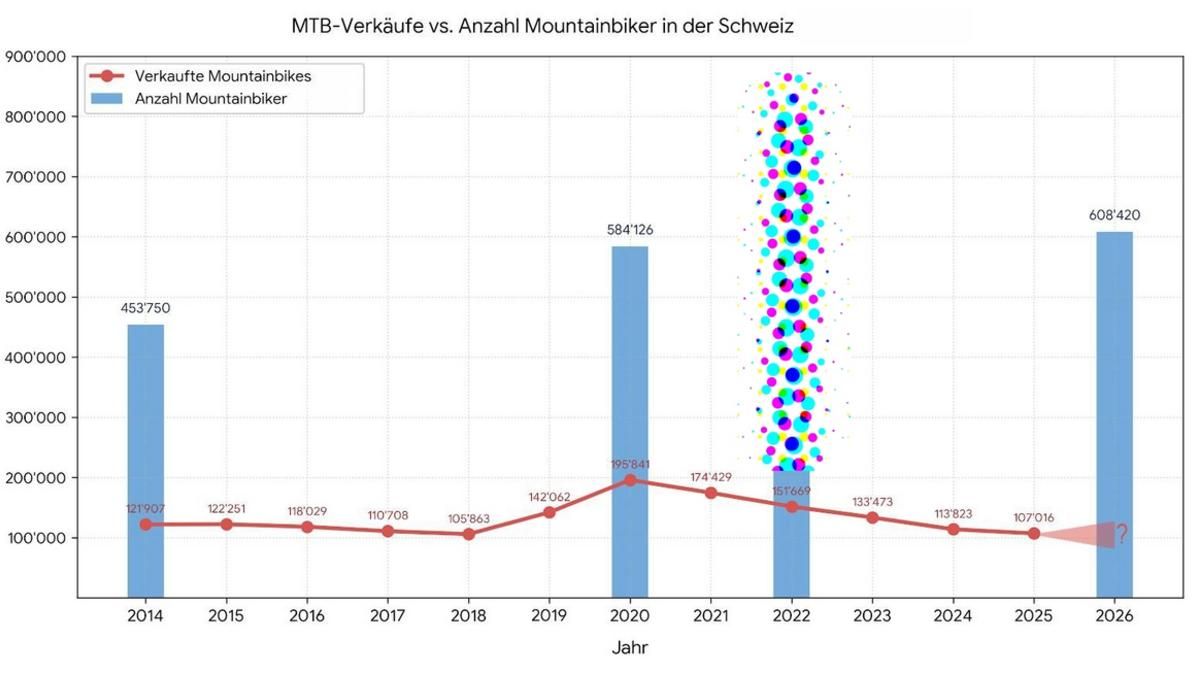
Regardless of whether we view the 200,000 female mountain bikers who joined the sport during the pandemic years as an outlier, the fact remains: This number of people used to ride regularly, and four years later, they no longer do. No one knows if these are the same people who have already stopped riding. The sample is reselected each time the Sport Schweiz study is conducted.
Three organizations have a vital interest in ensuring that many people in Switzerland cycle in their free time. Although mountain bikers are just one segment among many, they remain the largest. Sales figures over the past ten years alone show that far more people are riding on fat tires than on narrow racing tires. Although gravel riders receive a large share of the attention, their numbers are still nowhere near as high as those of female mountain bikers.
Velosuisse believes in the future of mountain biking
About one-third of the bicycles sold in Switzerland are mountain bikes, with or without a motor. This has been the case for many years. Velosuisse, the association of bicycle dealers in Switzerland, has therefore carefully reviewed the study and consulted additional surveys.
“The counting stations show that people aren’t cycling any less than they did four years ago—in fact, they’re cycling more,” says Velosuisse Managing Director Martin Platter. Another positive sign, he notes, is that mechanics’ shops continue to be consistently busy. This, too, points to active bicycle use. “Apparently, some cyclists don’t consider their rides to be a sport,” Platter explains.
Despite the continued importance of mountain bikes in sales, he emphasizes: “Our primary goal is for as many people as possible to ride bikes as much as possible.” The industry can use products to encourage people to do so. As examples, he cites 32-inch bikes, new competition from China in the motorized bike sector, and other innovations currently in the pipeline. “These will have a delayed impact,” he is convinced. Platter, a longtime mountain biker and mountain bike journalist, does not see mountain biking as being on the decline.
Swiss Cycling takes on the challenge
Swiss Cycling also has a strong interest in mountain biking. The national sports federation is responsible for ensuring that Switzerland consistently brings new athletes to the world’s elite. Not only in mountain biking, but also on the road, the track, and other venues. For many children, however, mountain biking is the gateway to cycling, even if they later compete in road or track races. In addition, Swiss Cycling has made it a priority to promote mountain bike infrastructure and recreational sports and intends to back up this commitment with action.
Urs Joller is the new Head of Policy and Infrastructure at Swiss Cycling. Commenting on the figures, he says: “We experienced an extraordinary peak during the pandemic. That gave us the chance to introduce people to the sport. Some have apparently stopped again.” He and the association see infrastructure as a possible reason. “Many people went out on their bikes to explore the surrounding area. For some, this likely became boring relatively quickly because there isn’t much to attract them in their region.” Perhaps inspired by his job description, Joller sees infrastructure as key to keeping mountain bikers engaged and getting new people excited about the sport.
He sees resentment toward mountain biking as another reason people give up the sport. “People are confronted in situations where they pose no danger and aren’t doing anything illegal. Swiss Cycling therefore expects the cantons to make a clear commitment to coexistence—including on hiking trails—as part of the implementation of the Bicycle Path Act.” “If you can only ride on attractive trails while on vacation, it’s an expensive hobby,” he explains. At the same time, he sees the Bicycle Paths Act—which the cantons are implementing with varying degrees of rigor—as an opportunity that must be seized.
Neither Velosuisse nor Swiss Cycling sees the survey results as indicative of a crisis. It is clear to everyone that this will require effort and new approaches to ensure that a significant number of people in Switzerland continue to ride mountain bikes.
Schweizmobil does not acknowledge the decline in mountain bikers
Schweizmobil maintains that the results are not comparable at all, since the sample size of the “Sport Schweiz Light” study published in 2022—at 2,130—is much smaller than that of the full versions published in 2020 and 2026. Over 15,000 people participated in those studies. It should be noted, however, that even 2,130 respondents allow for representative results. Various representative surveys are conducted in Switzerland with between 1,000 and 2,000 participants.
Whether a sample is representative, however, naturally depends on other factors, such as whether age groups and other demographics are represented in proportion to their shares of the total population. Schweizmobil explains: “Compared to the SportSchweiz 2019 survey, 25- to 34-year-olds are overrepresented and those over 60 are underrepresented in this ‘light’ special survey, while foreign nationals are significantly underrepresented. Additionally, there are differences in how sports are categorized.” By “SportSchweiz 2019,” Schweizmobil refers to the results published in 2020, which were collected the previous year.
From Schweizmobil’s perspective, only the studies conducted in 2008, 2014, 2020, and 2026 are comparable. A comparison between 2020 and 2026 shows that the proportion of people who mountain bike regularly has decreased by only 0.1 percent. “In absolute terms, this represents an increase from 550,000 to 585,000 people,” the national agency emphasizes to Ride. At the same time, the percentage of those who cite mountain biking as their primary sport has risen from 2 percent to 2.2 percent. Swiss Mobility also points out that there are striking differences between the language regions: In German-speaking Switzerland, the share of mountain bikers has risen by 0.9 percent. In French-speaking Switzerland, however, 2.3 percent fewer people reported biking regularly, and in Italian-speaking regions, the figure was down by as much as 4.7 percent.
These non-comparable survey results therefore merely suggest that more people rode mountain bikes during the COVID-19 years than before or after that period. The fact that stores were sold out during those years clearly indicates that this was the case. However, the author of this article acknowledges that the subsequent decline cannot be precisely quantified. Why mountain biking activity has shifted from French-speaking to German-speaking Switzerland is another question that will not be explored in depth here.
No responses from Pro Velo and Imba Switzerland
In response to an inquiry from Ride, Pro Velo explained that its focus is clearly on everyday cycling, which is why it does not comment on the number of female mountain bikers.
Imba Switzerland, which recently announced that it would focus on international networking with other trail promotion organizations in the future, consequently did not respond to the inquiry.
Further content on this article


Note: This content has been automatically translated from German. Please report any incorrect translations.