

I pack my backpack...
Less weight, more fun
There are still plenty of mountain bikers with huge rucksacks. But why so much luggage when you can do it with less? The argument that a three-day Hüttentour requires more small items is also only partially true
.
It makes a difference whether you are traveling alone or with two people. If there are more than two people, things like mini pumps, tools or other items can be divided up perfectly, as long as not everyone needs one of them, such as a spare inner tube. Ultimately, the less weight on your back, the less energy you use. However, riding is more fun if the rucksack remains small and light.
In addition, many bikes this year have small storage compartments in the frame, where small items such as a tube, mini tool, snacks or even a light jacket can be stored.
I pack in my (small) backpack...
For most day trips, small backpacks of six to ten liters are sufficient, for multi-day trips ten to about 15 liters - depending on the weather. In rainy weather, you may need to take a little more spare clothing, whereas in dry conditions and stable mountain weather, you can safely leave something at home. However, the following items should not be missing from your rucksack, because after all, you don't want your bike tour to end in a march or worse.
About walking: If you want to walk, the mountain bike will rest better on a full (not overfilled) rucksack than on a half-filled large rucksack during a hike-a-bike.
Packing list
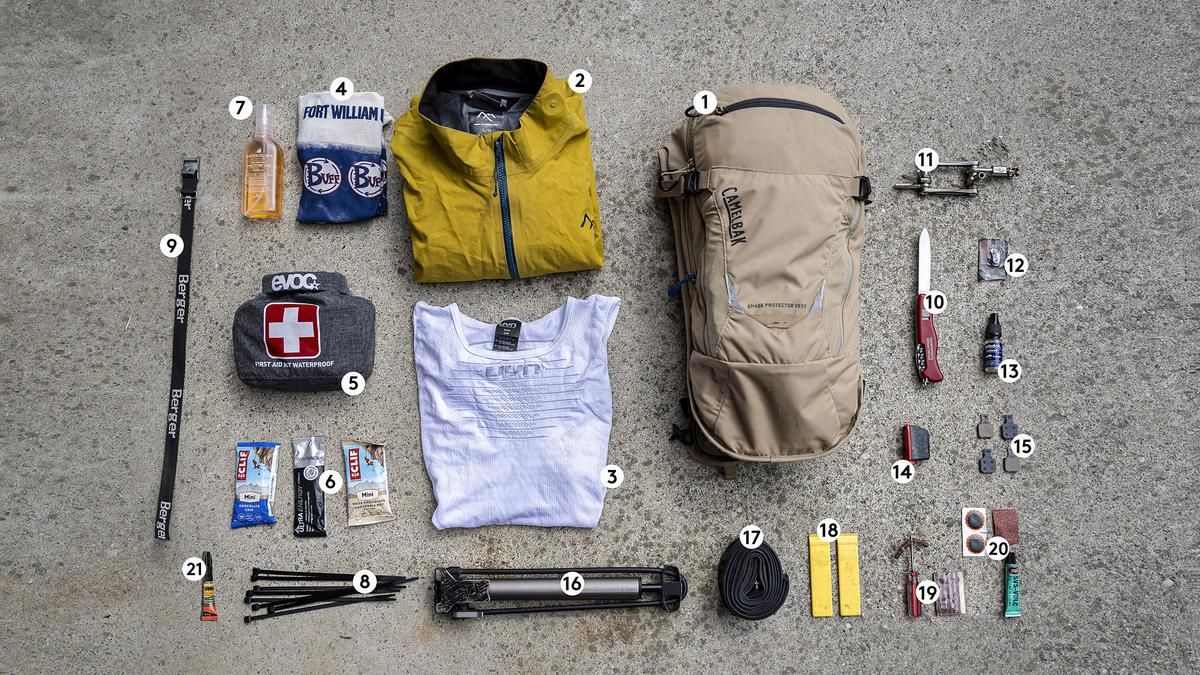
- A comfortable backpack, here for example the 8-liter Camelbak Protector Vest.
- You shouldn't skimp on a rain jacket; a down or Primaloft vest is also advisable on an alpine Hüttentour .
- Spare underwear: where a dry shirt underneath is sufficient for one-day tours, you can also bring fresh bib shorts and socks on multi-day tours.
- Multifunctional scarves such as those from Buff can be used as a headband, hat, neck or pulse warmer .
- The emergency first-aid kit can be more or less extensive, but a minimum of bandages and disinfectant are always a must.
- Snacks with a high energy density (e.g. fat gels based on vegetable oils) are more suitable for long tours than those with a high sugar content. The little sugar bomb, on the other hand, is perfect for sharpening your senses for the final descent. A small tube of sun cream or protective spray always finds a place in your rucksack.Cable ties are the best helpers to make the bike rideable again despite various minor damages.
- Although cable ties are not a must, pedal straps are extremely practical if you need to lash something to your backpack, bike or anywhere else.
- MacGyver taught us that you can do almost anything with a pocket knife. But when it comes to shortening tubeless plugs, much smaller cutting tools will do the trick.
- A multitool with a chain riveter should always be in your rucksack .
- Speaking of chain riveters, a suitable chain lock should not be missing either.
- Continue with the chain: A dry drive is annoying, shifts poorly and wears out much faster. That's why a small portion of chain oil should not be missing in your backpack.
- On long tours, a gear cable belongs in the backpack, for AXS users a spare battery .
- If you brake, you also lose brake pads. That's why you can take a spare with you on multi-day tours.
- A powerful mini pump belongs in your bike backpack.
- The same applies to the spare inner tube .
- With the right technique and strong fingers, you don't need tire levers, but sometimes things can turn out differently, and then you appreciate their presence.
- Tubeless patches, affectionately known as "salami" by many mountain bikers, are usually used to seal cuts in the tire.
- Tube patches are not essential, but they are practical.
- Superglue can also be used for repairing tires, for gluing "wandering" tubeless plugs, but also for closing lacerations if steristrips do not hold.
Further content on this article

Note: This content has been automatically translated from German. Please report any incorrect translations.