

Long-term test: Transition Patrol - the little one for the rough stuff
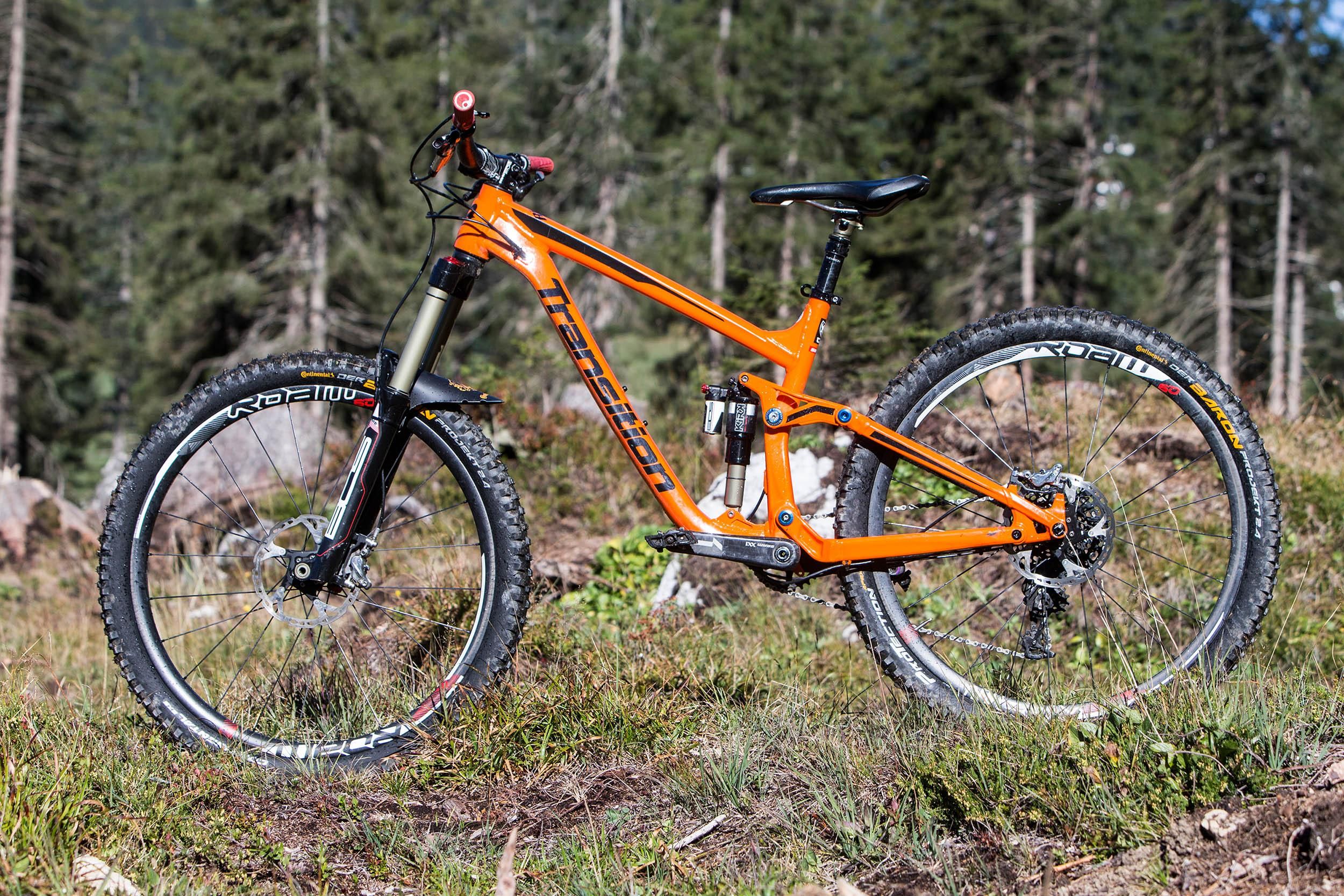
Until July 2014, the patent for the "Horst Link" in the USA was firmly in the hands of Specialized. When the patent expired, Transition presented its new fleet with the aforementioned linkage. Despite a dedicated fan community, the brand has not yet been able to reach the masses. This could possibly change. The new Patrol, Scout and Smuggler models have already been highly praised from various quarters. This also aroused our curiosity and interest in a long-term test of the "Patrol" all-mountain model.
The bike is available ex works in three equipment variants and as a frame kit. In order to combine the bike test with other product tests, we built the frame according to the available options.

The frame at a glance
The frame is available in two color variants: black or orange. We opted for orange and were almost a little shocked when the frame was unpacked. The color really pops and almost looks like a signal color. You can hardly imagine this color intensity from the pictures in the catalog or on the Internet. The quality of the paint is also striking. Without going into much more detail later, we can already reveal that the paint proved to be extremely robust throughout the entire test period.
Softeners and small parts delights
As the Swiss Transition importer also sells suspension elements from the French suspension specialist BOS, the course for the suspension was already set. At the front, the Deville fork with a 170 millimeter stroke is used, while at the rear a Kirk shock absorber is used to destroy the shocks. Roam 60 wheels from Sram are used as rolling stock, from which the XX1 drivetrain and RSC brakes also originate.
The "Covert" variable seatpost from Thomson creates space between the saddle and the rear. An Ergon SM3 Pro saddle is bolted to this, which corresponds to the buttock preferences of 50 percent of the Ride editorial team. The "Binary Carbon" joystick handlebars and the GE1 Slim grips from Ergon were also previously used privately.
Before the ride
The Patrol wasn't quite as fast as we had hoped, however, when we hit the trails. "The BOS suspension elements are to blame for this, as the adjustments are not as quick to make as with other products. Of course, as with Fox, Rock Shox and the like, with the right air pressure and adjusting the rebound you already have a usable setup. But the other adjustment options are quite overwhelming. You can either work your way through the adjustment options for low-speed and high-speed compression, rebound and progression or seek advice. Simply tinkering with the fork is definitely not the way to go with the Deville. However, once the air fork has been set up, the anticipation grows as soon as you try it out on the course.


During the ride
Despite the high-quality and therefore lightweight body, the scales remain at 13.6 kilograms. Not a lightweight for high-altitude tours. But thanks to the balanced geometry, the Transition is surprisingly easy to pedal uphill. Even day tours with hour-long climbs are easy to master. We only flipped the platform lever of the Kirk shock on asphalt climbs. Together with the kinematics of the rear suspension, the shock behaves almost drive-neutral. On uphill single trails, the four-link suspension plays to its strengths. It climbs nimbly over rough passages without the "Kirk" bending its knees too much. The good climbing characteristics are certainly enhanced by the very stiff and light Roam wheels.
When rolling along comfortably on single trails, the Patrol looks inconspicuous and you get the feeling of sitting on an average bike. But when you give the bike the spurs, its character quickly changes. Powerful acceleration is converted into propulsion and an active riding style really brings out the strengths of the Transition. Despite the long 1181 millimeter wheelbase, you can push the Patrol around the tightest corners and it can be steered very precisely. The 430 millimeter short chainstays are responsible for this. The long wheelbase is the result of the 581 millimeter long top tube and the 65 degree steering angle.
However, the low bottom bracket takes some getting used to. The low center of gravity positively supports maneuverability and smoothness, but on single trails you quickly hit the pedals on bumps. The 170 millimeter long cranks - the standard length on trail bikes - are already at the upper limit here.

Transition bikes are essentially more downhill-oriented, so the Patrol also has a pronounced downhill gene. It rides downhill like a small downhill bike. It seems as if the terrain can't be rough enough. With the Patrol, even such descents feel good and the feeling of being in control lasts a relatively long time. The high-quality BOS suspension plays its part here. The slack head angle, long wheelbase and reach (432 millimeters for frame size M) are certainly the main reasons why you can really let it rip on this bike. It also cuts a fine figure in the bike park. The Patrol not only jumps easily through the air, it also stays on track at high speeds for a bike with 155 millimeters of rear travel. Unfortunately, the rattling of the cables hitting the inside of the frame is noticeable.
Equipment under deep meter fireYou can tell that the BOS suspension elements have their origins in rallying. All details are of a very high quality, the compression and rebound (high and low speed) can be adjusted over a range of 30 clicks each. The manufacturer provides detailed instructions which give you a basic setup. Unfortunately, this doesn't really inspire us at first and doesn't suit the Patrol. Somehow we don't manage to get the setup 100 percent right at first. Only after a few rides do we notice a change. It seems that the suspension elements have settled in.
Back to field A and make the basic settings on the shock and fork again. We increase the negative suspension travel of the shock from 35 to 40 percent and then gradually adjust the rebound and compression damping by just one click at a time until it fits. And lo and behold, after a few descents the bike sticks to the ground as desired. The very sensitive response of the BOS products is very impressive. Despite a lot of negative travel, the Transition sits well in the mid-travel range and offers good end progression. The suspension travel is fully utilized on almost every exit.
During the five-month test phase, we subjected the Patrol to almost every conceivable situation. Snow and sub-zero temperatures in Davos, constant rain and mud in Zurich, around 40 degrees and 1000 non-stop meters of altitude in Bolzano to the blocked trails on Lake Garda. The XX1 drivetrain has suffered a few scratches along the way but has always changed gears reliably. So far, the gears have only needed a few adjustments, and that's saying something. The clamping force of the derailleur is so good that we never thought about a chain guide. It only jumped off the chainring once in the bike park.


After the Avid brakes from the Sram group have caused many users grief in the past, their new Guide brakes are convincing. The RSC model is a brake anchor and already impressed us in a practical test in spring. Lots of power, good modulation and no fading even when descending a good 1000 meters of altitude in one go. However, after prolonged and intensive use, it was necessary to bleed the air once. However, this was quick and uncomplicated. The problem that brakes with DOT brake fluid draw moisture in cellars and then lose performance did not occur with us either. The RSC is still as powerful as it was at the start of the test.
The Roam 60 wheels from Sram are a surprise for us. The internal dimension of the carbon rim is only 21 millimetres and they are therefore "only" designed for trail use. Consequently, we literally abused them. We rode the Roams with 2.4 inch wide tires - without a reinforced sidewall - with an air pressure of mostly 1.5 to 1.7 bar. The rims suffered a few punctures, only two of which resulted in a flat tire. Neither the blocked trails in Bolzano or Riva, nor the bike park use in Lenzerheide could do anything to the wheels. Although they have lost some of their spoke tension, they still turn like a charm.
The high-quality hubs impress with very good smooth running that has not changed by the end of the test. With the Roam-60, Sram has created a wheelset that strikes a good balance between stiffness for high acceleration and lateral flex for aggressive cornering. It is often the case that carbon wheels are too stiff, which has a particularly negative effect in fast, tight corners. Rolling material that is too stiff can also transmit vibrations to the rider, which is not only uncomfortable but can also lead to sensitivity problems in the hands. This is definitely not the case with the Roam-60.


We already reported on the Covert Dropper Elite dropper seatpost from Thomson in the 04/2015 issue of Ride. It impressed us back then and performed flawlessly over the entire time. The only problem was that the cable no longer wanted to cooperate after four months and broke. However, replacing the cable on the Thomson seatpost is very easy and only takes three minutes. This defect was therefore easy to get over.

We have not made any modifications to the Transition. As described, the custom setup was ridden for the entire duration of the test. The wear and tear on the components was within the usual range and apart from the aforementioned cable for the remote control of the dropper post and three hoses, nothing had to be replaced.
We only see potential for improvement in the frame in terms of cable routing, so that the cables and wires are well positioned in the future.
Conclusion
The Transition Patrol is a full-grown enduro bike that can be ridden fast and actively, but is not afraid of long climbs. If you want to test the limits of this bike, you have to really step on the gas. The Patrol that we built up impresses with its plush suspension and sufficient end progression. The Bos suspension elements play a big part in this.
Specifications
| Frame material: | Aluminum |
| Price: | CHF 9'970.00 Custom body (from CHF 2'999.00) |
| Weight: | 13.6 kg (size M, with pedals) |
| Suspension travel: | 170 mm front / 155 mm rear |
| Fork: | BOS Deville |
| Suspension strut: | BOS Kirk |
| Shifting: | Sram XX1 |
| Brakes: | Sram Guide RSC |
| Crankset: | Sram XX1 |
| Rims: | Sram Roam 60 |
| Hubs: | Sram Roam 60 |
| Tires: | Continental Baron Project 2.4 |
| Saddle: | Ergon SM3 Pro |
| Saddle post: | Thomson Elite Dropper Covert |
| Grips: | Ergon GE1 |
| stem: | Race Face Atlas |
| handlebars: | Joystick Binary Carbon |
Manufacturer: www.transitionbikes.com
Distribution: www.magicdownhill.com
Photos ©Philipp Ruggli
Note: This content has been automatically translated from German. Please report any incorrect translations.