

Mountain Bikers in the Crosshairs: When Hunters Shoot at People
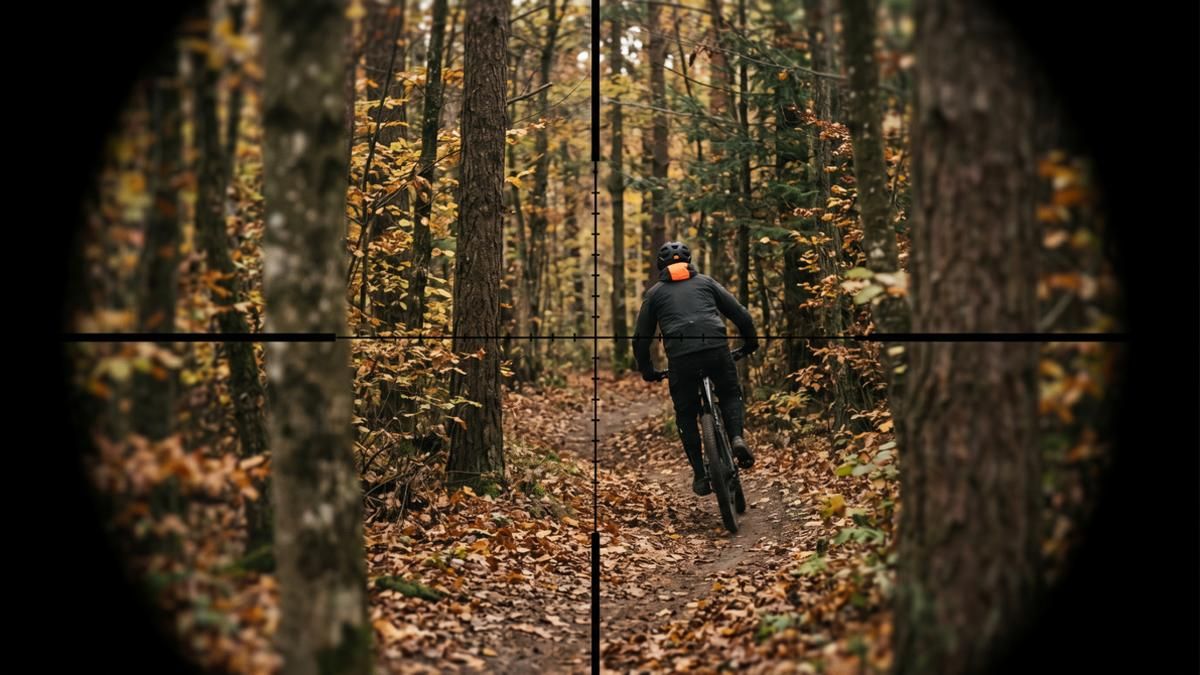
The shot was fired near Girona, Spain. A 54-year-old cyclist, mistaken for a wild boar, barely survived. Shot in the abdomen, he underwent multiple emergency surgeries; the shooter was arrested on charges of negligence. Near Chapella in the canton of Graubünden, the bullet struck not a deer but an Icelandic horse.
Chaumont, canton of Neuchâtel: A mountain biker approaches within fifty meters, clearly visible on a wide trail. The hunter turns toward him, rifle at the ready, and keeps him at gunpoint for a while. Three to four seconds pass before he realizes: it’s not game—it’s a cyclist. This time, no shot is fired. The incident becomes public; the French-Swiss television station RTS reports on it, sparking a debate about a possible ban on alcohol while hunting. Whether the hunter had actually been drinking was never officially determined. The president of the Neuchâtel Hunters’ Association regrets the incident, yet his only public criticism is directed not at the hunter but at the mountain biker: he did not call the police immediately.
False Trail
This makes him an exception among documented misfires. Alcohol plays hardly any role overall; in France, only 3.3 percent of the hunters tested were intoxicated. Inexperience doesn’t explain it either; on the contrary: In New Zealand analyses, the shooter was an experienced hunter in over two-thirds of the cases. Nor does poor visibility—the average distance is around 35 meters, and the shooter often observed his target for minutes on end in daylight.
In crime novels, the most obvious explanation is usually the wrong one. Here, however, it corresponds quite closely to reality: Those who make themselves conspicuous are less likely to be overlooked. Studies of North American hunting accident statistics revealed that the vast majority of hunters routinely wore orange—a good four out of five. Among the victims of mistaken identity—those who were mistaken for game and shot—only 6 out of 125 were wearing a conspicuous color. In the fatal cases from a second survey, none of the twenty-one were wearing such a color. For mountain bikers, a bright helmet or a high-visibility vest during hunting season would not be a fashion accessory, but a genuine safety measure. Yet hardly anyone wears one.
Deer have dichromatic vision, with only two types of cones in their eyes instead of three. They lack the cone responsible for long wavelengths, which allows humans to see red and orange. What appears brightly colored to us looks like a dull brown or gray to a deer. The camouflage patterns underneath serve a different purpose: they break up the human silhouette so that the deer does not recognize the hunter as a threat. Camouflaged, the hunter blends into the surroundings. Two layers of clothing, two opposing goals: visible to humans, invisible to the animal. This explains why game isn’t scared of bright colors. Near Chaumont, however, visibility didn’t help. So we can’t rely on it entirely.
What the Eye Seeks
If you have your eye on a new mountain bike, you suddenly see it everywhere—on the trail, at the bike park, in store windows. It hasn’t actually become more common. Psychologists call this the frequency illusion: whatever is currently on your mind, the brain preferentially filters out of your surroundings. This same filter has a downside. It blocks out anything that doesn’t fit the category you’re looking for, even if it’s right in front of you and glowing brightly. This is called inattentional blindness. While hunting, the eye searches for game. As a result, a person wearing high-visibility clothing is sometimes simply not consciously noticed. Under more challenging conditions—at twilight, from a distance, or while in motion—that person can even actively become a supposed deer: a misclassification, not a sensory illusion. In both cases, the eyes provide the correct signals. What becomes of them is decided only afterward, in the mind.
The filter has an advantage; otherwise, evolution would have eliminated it long ago. The eye provides the brain with an estimated ten million bits of information per second; only about forty of these reach the conscious mind. Without a filter, the brain would be just as preoccupied with every sunspot in the canopy as with a movement in the underbrush that might indicate danger. For our ancestors, this filter was essential for survival. A rustle in the underbrush had to be recognized immediately as a danger, while the steady murmur of the nearby river could be safely ignored. Selective attention blocks out what is irrelevant to the current goal so that what is relevant can be processed more quickly. For a hunter, the goal is to spot game. Everything else becomes secondary, even if it glows brightly.
Familiarity with the terrain and peer pressure further intensify this effect. Anyone who waits for game in the same tree stand year after year knows every tree stump. Familiarity allows the brain to operate on autopilot, paying less attention to what is new. The role of peer pressure in this context is evident during a driven hunt. Dozens of hunters are stationed in position, while beaters and dogs drive the game out of the thicket. The goal is to bag as many animals as possible in the shortest amount of time. Under this pressure, hunters shoot faster, with less time to focus. For a mountain biker, this could turn into a precarious situation. The hunter scans the thicket, expecting something to dart out at any moment, while the beaters time it to the split second. Movement at this spot, at this very moment, almost confirms the expectation before the eye can even tell what is actually moving there. The script for a driven hunt calls for an animal at this point—not a person on two wheels.
Attention doesn’t follow what’s there, but what one is currently looking for. This mechanism is also evident on the trail, only in reverse. Steering follows the gaze; wherever the eyes are aimed, the body steers—whether on a mountain bike or a motorcycle. When fear sets in, a second shift occurs: the gaze automatically jumps to the threat, even before the mind can intervene. Anyone startled by a root stares exactly where they don’t want to go. The body follows the gaze.
The hunter overlooks what he doesn’t expect. The mountain biker rides straight into what he fears. In both cases, it is not the eye that decides, but rather what the attention is already focused on before the will intervenes: the deer in the hunter’s mind, the root in the biker’s mind.
What the shot leaves behind for the shooter
In the case of a fatal misfire, there are almost always two victims. Anyone who unintentionally kills someone suffers afterward from shock, guilt, anger, depression, and family strain—sometimes for years on end. So it’s not just a matter of how mountain bikers and hikers can protect themselves in the woods. Far more interesting is what the hunter can do to prevent a misfire from happening in the first place. High-visibility colors help prevent being overlooked—that’s a proven fact. But a piece of clothing does little to counteract the mental filter in the shooter’s mind, which perceives expected game rather than an unexpected person.
“Identify your target beyond a doubt before you pull the trigger”: one of the four basic rules of every hunting training program worldwide. Yet this rule clearly isn’t always reliable. Most hunters who miss their targets are experienced, trained hunters. Consciously trying to counter an unconscious filter with a rule rarely works. The filter has been optimized over hundreds of thousands of years; it works quickly, automatically, and unconsciously. The rule, on the other hand, is a few decades old and must be consciously reconsidered each time, slowly. A thought often comes too late to counter a reflex that has already made its decision. When the mind is searching for game, everything else becomes secondary, no matter what it is. In a forest once used only by hunters, this wasn’t a problem. In a forest where cyclists, hikers, and joggers also venture today, this efficiency becomes a trap. So can the filter itself be trained—not just the rule intended to override it?
In a newer training approach, practice doesn’t involve predictable targets. Instead, unpredictable locations and times of appearance are simulated so that no pattern becomes ingrained that the filter would simply have to confirm in a real-life situation. A small field trial with former police officers showed fewer missed targets and fewer targets shot at incorrectly. This technology isn’t available for hunting yet, but it still sounds promising.
It took the hunter near Chaumont a while to realize what was standing right in front of him. During that moment, more was at stake than a missed shot: a human life on one side of the barrel, and—had the shot been fired—a second life on the other, one that could never have fully forgiven itself.

About the author: Men Danuser
Note: This content has been automatically translated from German. Please report any incorrect translations.