

Rampage & Co. - today's form of Circus Maximus?
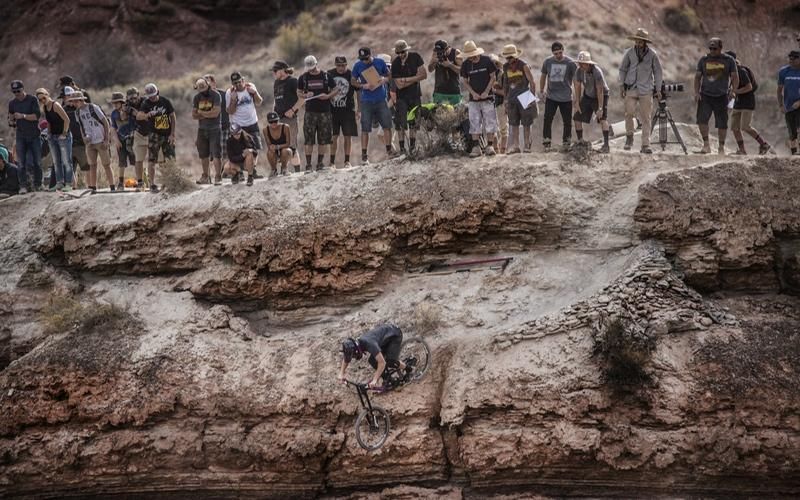
The Redbull Rampage is the annual highlight in the mountain bike freeride sector and also the finale of the "Freeride Mountain Bike World Tour". This big mountain event in the Uthas desert is a cult event and an integral part of the mountain bike event calendar. But where an event finds a continuation, it must not stagnate. In this case, it must become more extreme, which has indeed been the case in recent years. Mind you, the Rampage is not alone in this. There are many other sports in which things are constantly taken to extremes for the sake of spectators and athletes take high risks.
When you looked at the Rampage course, you didn't get the feeling that it was any more extreme than last year. After all, it was already extreme enough in 2014. Nevertheless, there is still room for improvement, as it is the riders who are daring more and more in order to fish for the coveted crown and the high prize money. Backflips, frontflips and 360s are no longer a rarity over the big jumps and deep drops. Even the drops that the riders choose in their line are sometimes so high that just looking at them makes you fear for the riders.Nicholi Rogatkin and Nico Vink crashed extremely spectacularly in the qualifying round of this year's Redbull Rampage. Rogatkin crashed over a cliff and Vink fell heavily after a drop. Surprising, but both got off relatively lightly. But it could have been worse, which was the case in the final run on Friday. Paul Basagoitia jumped too far after a big drop, but was just able to stay on his bike. However, his control was briefly lost, which caused him to leverage out. Basagoitia crashed over a small edge and came to a stop. The result was a fracture of the lowest thoracic vertebra and a loss of feeling in his legs. After a nine-hour operation, the American is still in hospital. There is a chance that he will be able to walk again at some point, but the further consequences for him are not yet foreseeable.
The participants of the Rampage cannot be accused of not being sufficiently fit or technically capable of mastering such a run. Basagoitia himself even belonged to the extended circle of favorites. But at the Rampage, everyone is at the limit. Accidents are part of "daily business" when riding at the limit, and it's no different in alpine skiing or Formula 1. But at the Rampage, it is not possible to secure lines as well as at the Lauberhorn or even set up crash zones.
We share the blame
There is probably no answer to the question of the purpose of such events, just as there is no answer to the question of who is to blame in the event of accidents. Opponents of such extreme events blame Red Bull and their ilk for the fact that athletes are exposing themselves to ever greater risks. But instead of blaming others, everyone needs to take a look at themselves - every Rampage spectator carries a certain moral guilt on their shoulders. After all, the Circus Maximus, as it existed in ancient Rome, never disappeared completely and exists today in the form of extreme sport, which draws spectators to the site or behind the screens.
I'm no exception, and every year I think to myself: "This time I'm not watching the live broadcast." Together with friends, however, I once again enjoy the incredible runs of the Rampage participants. Every dicey moment makes me cringe and every fall makes me shudder. My friends are no different, and yet we meet up every year to watch Rampage together - just like in the Circus Maximus in ancient Rome, where gladiators fought lions and often didn't survive.
With this realization, we have to admit to ourselves that this is exactly the kind of spectacle we want to see. Not that we wish even one athlete an injury, but we still want the action. However, it is also things that we ourselves are not capable of that make such events so appealing. So as long as we want to watch such action sports events, we share some of the blame for every injury. We spectators are also the reason why the industry is involved in such events or athletes as sponsors. Without spectators there are no sponsors, without sponsors there is no prize money and without prize money there is no risk. The equation is that simple.
But the athletes are not to blame either. It's easy to claim that sponsors put pressure on athletes. I've experienced that myself, it's also part of life. If you don't perform in your "normal" professional life, you'll also be put under pressure there. The difference is that in sport, every athlete has the freedom to decide for themselves whether they want to do this or not. But those who say no need a good backbone. This can lead to the loss of sponsors - and what athlete likes to give up their dream? Even if I was "only" allowed to live this dream in endurance sports, it's ultimately the same thing - albeit with more relevant health consequences at the Rampage.
The question of meaning and guilt is a moot point and cannot be answered. Sensation is part of human behavior, and has been for thousands of years. Today, the Circus Maximus is simply in Utah or on the Lauberhorn and is broadcast live around the world. That's why I'll tell myself again next year that I won't be following the Rampage for moral reasons - and then do it anyway. Like many other mountain bike enthusiasts around the world.
Ride editor Balz Weber was a professional mountain biker for many years with various World Cup teams, his greatest success was the world championship title in the U23 class in Lugano in 2003.
Note: This content has been automatically translated from German. Please report any incorrect translations.